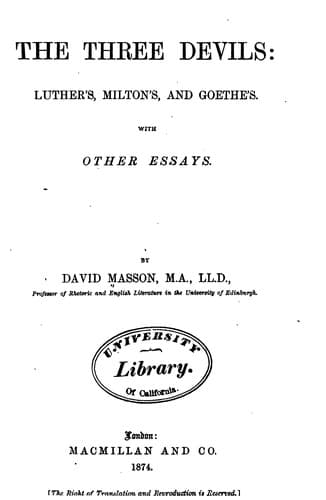
The Three Devils: Luther's, Milton's, and Goethe's; With Other Essays — John Shaqi
The Three Devils: Luther's, Milton's, and Goethe's; With Other EssaysMasson, David
History
The Three Devils: Luther's, Milton's, and Goethe's; With Other Essays
Masson, David
Devil in literature; Literature -- History and criticism
But how to evolve Shakespeare from his works, how to compel this Proteus
into his proper and native form, is still the question. It is a problem
of the highest difficulty. Something, indeed, of the poet's personal
character and views we cannot help gathering as we read his dramas.
Passages again and again occur of which, from their peculiar effect upon
ourselves, from their conceivable reference to what we know of the poet's
circumstances, or from their evident superfluousness and warmth, we do not
hesitate to aver "There speaks the poet's own heart." But to show
generally how much of the man has passed into the poet, and how it is that
his personal bent and peculiarities are to be surely detected inhering in
writings whose essential character it is to be arbitrary and universal, is
a task from which a critic might well shrink, were he left merely to the
ordinary resources of critical ingenuity without any positive and
ascertained clue.
In this case, however, all the world ought to know, there is a positive
and ascertained clue. Shakespeare has left to us not merely a collection
of dramas, the exercises of his creative phantasy in a world of ideal
matter, but also certain poems which are assuredly and expressly
autobiographic. Criticism seems now pretty conclusively to have
determined, what it ought to have determined long ago, that the _Sonnets_
of Shakespeare are, and can possibly be, nothing else than a poetical
record of his own feelings and experience--a connected series of entries,
as it were, in his own diary--during a certain period of his London life.
This, we say, is conclusively determined and agreed upon; and whoever does
not, to some extent, hold this view knows nothing about the subject.
Ulrici, who is a genuine investigator, as well as a profound critic, is,
of course, right on this point. So, also, in the main, is M. Guizot,
although he mars the worth of the conclusion by adducing the foolish
theory of _Euphuism_--that is, of the adoption of an affected style of
expression in vogue in Shakespeare's age--in order to explain away that
which is precisely the most important thing about the Sonnets, and the
very thing _not_ to be explained away: namely, the depth and strangeness
of their pervading sentiment, and the curious hyperbolism of their style.
In truth, it is the very closeness of the contact into which the right
view of the Sonnets brings us with Shakespeare, the very value of the
information respecting him to which it opens the way, that operates
against it. Where we have so eager a desire to know, there we fear to
believe, lest what we have once cherished on so great a subject we should
be obliged again to give up, or lest, if our imaginations should dare to
figure aught too exact and familiar regarding the traits and motions of so
royal a spirit, the question should be put to us, what _we_ can know of
the halls of a palace, or the mantled tread of a king? Still the fact is
as it is.
Public-domain text, read in full here on John Shaqi.
Reviews
Reviews
No reviews yet
Be the first to share your thoughts on this work.
Join the Discussion
Join the discussion
Sign in to leave a comment or review.
Sign InorCreate an account