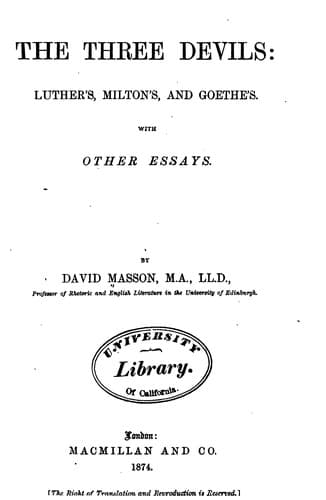
The Three Devils: Luther's, Milton's, and Goethe's; With Other EssaysMasson, David
History
The Three Devils: Luther's, Milton's, and Goethe's; With Other Essays
Masson, David
Devil in literature; Literature -- History and criticism
These Sonnets of Shakespeare _are_ autobiographic--distinctly,
intensely, painfully autobiographic, although in a style and after a
fashion of autobiography so peculiar that we can cite only Dante in his
_Vita Nuova_, and Tennyson in his _In Memoriam_, as having furnished
similar examples of it.
We are not going to examine the Sonnets in detail here, nor to tell the
story which they involve as a whole. We will indicate generally, however,
the impression which, we think, a close investigation of them will
infallibly leave on any thoughtful reader, as to the characteristic
personal qualities of that mind the larger and more factitious emanations
from which still cover and astonish the world.
The general and aggregate effect, then, of these Sonnets, as contributing
to our knowledge of Shakespeare as a man, is to antiquate, or at least to
reduce very much in value, the common idea of him implied in such phrases
as William the Calm, William the Cheerful, and the like. These phrases are
true, when understood in a certain very obvious sense; but, if we were to
select that designation which would, as we think, express Shakespeare in
his most intimate and private relations to man and nature, we should
rather say William the Meditative, William the Metaphysical, or William
the Melancholy. Let not the reader, full of the just idea of Shakespeare's
wonderful concreteness as a poet, be staggered by the second of these
phrases. The phrase is a good phrase; etymologically, it is perhaps the
best phrase we could here use; and whatever of inappropriateness there may
seem to be in it proceeds from false associations, and will vanish, we
hope, before we have done with it. Nor let it be supposed that, in using,
as nearly synonymous, the word Melancholy, we mean anything so absurd as
that the author of Falstaff was a Werther. What we mean is that there is
evidence in the Sonnets, corroborated by other proof on all hands, that
the mind of Shakespeare, when left to itself, was apt to sink into that
state in which thoughts of what is sad and mysterious in the universe most
easily come and go.
Public-domain text, read in full here on John Shaqi.
Reviews
Reviews
No reviews yet
Be the first to share your thoughts on this work.
Join the Discussion
Join the discussion
Sign in to leave a comment or review.
Sign InorCreate an account