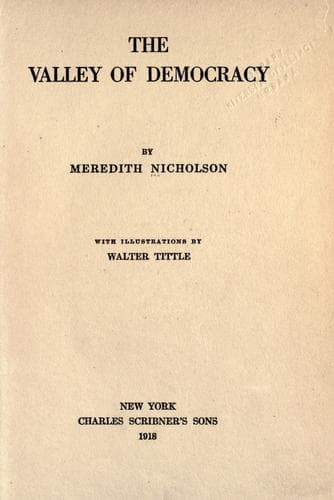
Mississippi River Valley -- Social life and customs
The lines of contact between isolated clearings and meagre settlements
were never wholly broken. Months might pass without a household seeing
a strange face, but always some one was on the way--an itinerant
missionary, a lost hunter, a pioneer looking for a new field to
conquer. Motoring at ease through the country, one marvels at the
journeys accomplished when blazed trails were the only highways. A
pioneer railroad-builder once told me of a pilgrimage he made on
horseback from northern Indiana to the Hermitage in Tennessee to meet
Old Hickory face to face. Jackson had captivated his boyish fancy and
this arduous journey was a small price to pay for the honor of viewing
the hero on his own acres. I may add that this gentleman achieved his
centennial, remaining a steadfast adherent of Jacksonian democracy to
the end of his life. Once I accompanied him to the polls and he donned
a silk hat for the occasion, as appropriate to the dignified exercise
of his franchise.
There was a distinct type of restless, adventurous pioneer who liked
to keep a little ahead of civilization; who found that he could not
breathe freely when his farm, acquainted for only a few years with
the plough, became the centre of a neighborhood. Men of this sort
persuaded themselves that there was better land to be had farther
on, though, more or less consciously, it was freedom they craved.
The exodus of the Lincolns from Kentucky through Indiana, where they
lingered fourteen years before seeking a new home in Illinois, is
typical of the pioneer restlessness. In a day when the effects of
a household could be moved in one wagon and convoyed by the family
on horseback, these transitions were undertaken with the utmost
light-heartedness. Only a little while ago I heard a woman of eighty
describe her family’s removal from Kentucky to Illinois, a wide détour
being made that they might visit a distant relative in central Indiana.
This, from her recital, must have been the jolliest of excursions, for
the children at least, with the daily experiences of fording streams,
the constant uncertainties as to the trail, and the camping out in the
woods when no cabin offered shelter.
Public-domain text, read in full here on John Shaqi.
Reviews
Reviews
No reviews yet
Be the first to share your thoughts on this work.
Join the Discussion
Join the discussion
Sign in to leave a comment or review.
Sign InorCreate an account