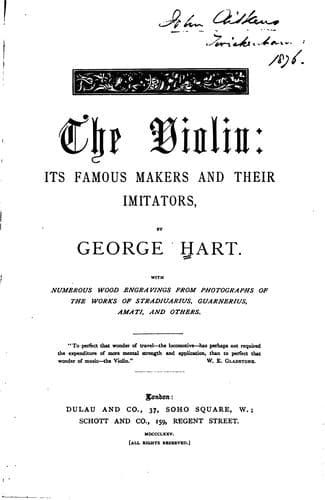
The Violin: Its Famous Makers and Their Imitators — John Shaqi
The Violin: Its Famous Makers and Their ImitatorsHart, George
History
The Violin: Its Famous Makers and Their Imitators
Hart, George
Violin -- History; Violin makers -- Biography
| | | | | |
| The total of | | | | |
| four thick | | | | |
| strings is | 62-3/4 | 27 13-1/4 | 16 12 | 11 1-1/4 |
| | | | | |
| The total of | | | | |
| four small | | | | |
| strings is | 52-1/2 | 23 5 | 13 10 | 9 11 |
+----------------+------------+------------+------------+------------+
B A C is the average angle formed by a string passing over the bridge
of a Violin, and the tension acts equally in the direction A B, A C.
[Illustration of angles of the strings.]
Take A C=A B.
From the point B draw B D parallel to A C. And from the point C draw
C D parallel to A B, cutting B D at D.
Join A D.
Then, if a force acting on the point A, in the direction of A B, be
represented in magnitude by the line A B, an equal force acting in the
direction A C will be represented by the line A C, and the diagonal
A D will represent the direction and magnitude of the force acting on
the point A, to keep it at rest.
N.B.--The bridge of a Violin does not divide the angle B A C quite
equally, but so nearly that A D may be taken as the position of the
bridge.
Also, the plane passing through the string of a Violin, on both sides
of the bridge, is not quite perpendicular to the belly. To introduce
this variation into the calculation would render that less simple, and
it will be sufficient to state that about the 150th part must be
deducted from the downward pressures given in the above table from the
first and fourth strings, and about the 300th part for the second and
third strings. The total to be deducted for the four strings will not
exceed three ounces.
On the line A B or A C set off a scale of equal parts, beginning at A,
and on A D a similar scale beginning at A.
Mark off on the scale A B as many divisions as there are lbs. in the
tension of a string, for example 18, and from that point draw a line
parallel to B D, cutting A D at the point 8 in that scale. Then, if
the tension of a string be 18 lb., the downward pressure on the bridge
will be 8 lb.; and therefore for the above angle the downward pressure
of any string on the bridge will be 8/18=4/9 of the tension of that
string.
The whole of the downward pressure of the first string falls upon the
Treble Foot of the Bridge.
The downward pressure of the second string is about 2/3 the Treble
Foot of the Bridge, and 1/3 on the Bass Foot.
The downward pressure of the third string is about 1/3 on the Treble
Foot, and 2/3 on the Bass Foot.
The whole of the downward pressure of the fourth string falls upon the
Bass Foot of the Bridge.
SECTION IV
The Italian School
Public-domain text, read in full here on John Shaqi.
Reviews
Reviews
No reviews yet
Be the first to share your thoughts on this work.
Join the Discussion
Join the discussion
Sign in to leave a comment or review.
Sign InorCreate an account