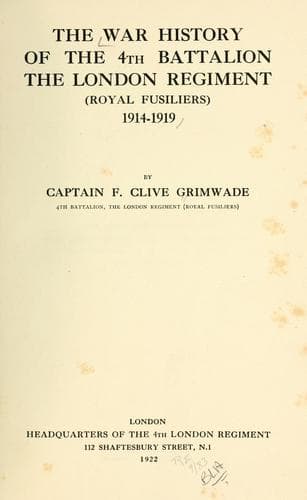
The War History of the 4th Battalion, the London Regiment (Royal Fusiliers), 1914-1919Grimwade, F. Clive
History
The War History of the 4th Battalion, the London Regiment (Royal Fusiliers), 1914-1919
Grimwade, F. Clive
Great Britain. Army. London Regiment. 4th (City of London) Battalion; World War, 1914-1918 -- Regimental histories -- Great Britain
A "Halte Repas," that is a halt just not long enough to enable the
troops to detrain and cook dinners, was made at Macon, after which
the journey, which resolved itself practically into a triumphal
progress, was resumed. At one wayside station, the name of which has,
unfortunately, passed from our recollection, a military guard of honour
saluted the arrival of the Battalion, while the ladies of the district
appeared with offerings of milk, coffee, and bouquets. So great, in
fact, was the enthusiasm that M. le Maire sent for a cask of wine in
which to assert his faith in the Entente Cordiale! Unhappily the French
railway authorities were not stirred by such intense emotion and the
train moved on before the wine arrived.
By the morning of the 8th the train was skirting Paris, and that day
the first signs of war were reached. Near Chantilly (the famous French
racecourse) reserve lines of trenches forming the outer ring of the
Paris Defences were passed, while at Creil some buildings severely
damaged by shell fire stood as stern remembrances of the great retreat
three months earlier.
This amusing though very tedious railway journey terminated at 9 p.m.
on the 7th January, when the Battalion detrained some ten miles south
of Boulogne at Etaples, at that date a small, muddy, and evil-smelling
fishing village. Etaples, which at a later stage of the war became such
an important base camp, with accommodation for some thirty thousand
men and many hospitals, was, in January 1915, not used as a British
military station, and the 1st London Brigade were the first troops
to be quartered there. Accommodation was provided under canvas in an
exposed situation, and the severity of the weather, which was intensely
cold and windy with occasional falls of snow, formed a contrast to the
sub-tropical climate in which the Battalion had been basking ten days
previously, which can only evoke surprise at the comparatively small
amount of sickness which ensued.
The Battalion had, it will be remembered, left its rifles, equipment,
and transport in Malta, and the refitting and equipment of the troops
was taken in hand at once. The first step was the reorganisation of the
Battalion in four companies, as follows:
New A Company--Old A and C Companies;
Captain H. J. Duncan-Teape in command.
Captain W. G. Clark second in command.
New B Company--Old B and F Companies;
Captain W. Moore in command.
Captain F. C. Grimwade second in command.
New C Company--Old D and E Companies;
Captain G. H. M. Vine in command.
2/Lieut. W. H. Weathersbee second in command.
New D Company--Old G and H Companies;
Captain C. R. Saunders in command.
Captain H. P. L. Cart de Lafontaine second in command.
The Company Sergeant-Majors were respectively Edwards, Elsom,
Chennels, and Cornwall.
Public-domain text, read in full here on John Shaqi.
Reviews
Reviews
No reviews yet
Be the first to share your thoughts on this work.
Join the Discussion
Join the discussion
Sign in to leave a comment or review.
Sign InorCreate an account