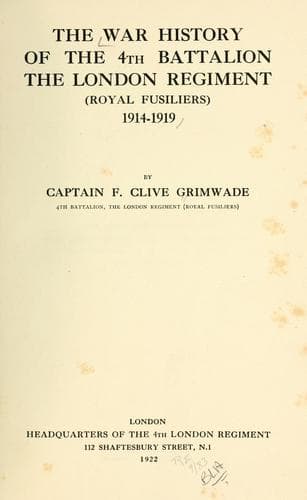
The War History of the 4th Battalion, the London Regiment (Royal Fusiliers), 1914-1919Grimwade, F. Clive
History
The War History of the 4th Battalion, the London Regiment (Royal Fusiliers), 1914-1919
Grimwade, F. Clive
Great Britain. Army. London Regiment. 4th (City of London) Battalion; World War, 1914-1918 -- Regimental histories -- Great Britain
In addition to this reorganisation the Battalion was issued with new
rifles of the long charger-loading type, with four Vickers guns, and
with new equipment of the 1914 pattern (webbing); and a refit of
clothing and necessaries was effected. Steps were also taken to dispose
of the surplus baggage and personal belongings acquired by all ranks
in Malta, and to reduce all to the scales of weight permissible in the
field.
Command of the Regimental Transport was assumed by 2/Lieut. R. L.
Herring, who proceeded with his section to Abbeville, and returned by
road with the full war scale of 1st and 2nd Line Transport and the
Battalion chargers.
These preparations which occupied the Battalion until the 25th January
were interspersed with such training as the state of the weather
permitted, the training being carried out on the sand dunes north of
Etaples. A warning order was received on the 25th to proceed to billets
near St Omer to join G.H.Q. Reserve.
The following day the Battalion moved by train from Etaples to St
Omer, and thence by march route to the billeting area which had been
allotted to it in two small straggling villages called Helfaut and
Bilques, where it arrived about midnight. At this point the Battalions
of the 1st London Brigade parted company until once more reassembled by
the formation of the 56th Division a year later.
Billeting in the early days of the war was not the simple matter
which it became at a later stage. For one thing, in most villages
neither wire beds, cook-houses, nor ablutions existed for the troops,
and the accommodation of barns and stables had not been tabulated by
Town-Majors ready for the use of billeting officers. All negotiations
for billets had therefore to be conducted by the billeting officer
direct with the communal authorities, through whom also straw and fuel
were drawn.
After a few days in Helfaut and Bilques the Battalion was driven from
its billets by an epidemic of measles which attacked the civilian
inhabitants, and it found fresh quarters slightly nearer St Omer in a
more important village called Blendecques.
Public-domain text, read in full here on John Shaqi.
Reviews
Reviews
No reviews yet
Be the first to share your thoughts on this work.
Join the Discussion
Join the discussion
Sign in to leave a comment or review.
Sign InorCreate an account