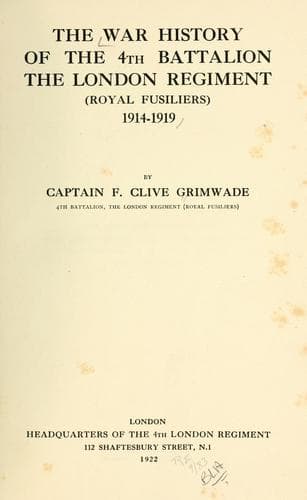
The War History of the 4th Battalion, the London Regiment (Royal Fusiliers), 1914-1919 — John Shaqi
The War History of the 4th Battalion, the London Regiment (Royal Fusiliers), 1914-1919Grimwade, F. Clive
History
The War History of the 4th Battalion, the London Regiment (Royal Fusiliers), 1914-1919
Grimwade, F. Clive
Great Britain. Army. London Regiment. 4th (City of London) Battalion; World War, 1914-1918 -- Regimental histories -- Great Britain
The 1/4th Londons now embarked on a course of very severe training
under the immediate supervision of the Inspector of Infantry,
Brigadier-General Oxley. This was, indeed, a strenuous three weeks,
with breakfasts at 7.30 a.m. and dinners at 5 p.m., the hours between
being occupied in tactical exercises. Usually a march of five miles in
each direction to and from the training ground was involved and the
exercise itself was almost invariably the "Attack in Open Warfare." In
every conceivable formation, over every conceivable sort of ground,
did the Battalion attack every one of the villages within reach of
Blendecques, till at last it was entirely weary of the attack in any
shape or form! But the grounding in field work thus obtained was
excellent and so completely were the lessons rubbed into the mind
of every member of the Battalion that this wearisome training bore
excellent fruit as we shall see later.
Once or twice a slight variation of training was obtained in work on
a new reserve line of trenches then being constructed east of St
Omer. This work was carried out under R.E. supervision. The design of
these trenches was strange. Their like was indeed never met with in
any sector of the line held by the Battalion in the whole of its war
service, and we can only be thankful that this reserve line never came
into active use.
Throughout the training period the weather was continuously wet and
cold, and these adverse conditions, added to the long hours without
food, imposed a serious physical strain on all, and the news that the
Battalion had been passed fit to join a brigade was therefore received
by all ranks with extreme satisfaction.
At Blendecques the Battalion was joined by Lieut. A. Hurd, R.A.M.C.,
medical officer, vice Captain Casey to hospital. 2/Lieut. E. W.
Bottomley was also evacuated to hospital.
On the 19th February the 1/4th Londons left the many good friends they
had made in Blendecques and marched through Wittes, where it halted for
the night, to Ham-en-Artois, arriving at 12.30 p.m. on the 20th, and
joined the Ferozepore Brigade of the Lahore Division.
The Indian Corps (Lieut.-Gen. Sir James Willcocks, G.C.M.G., K.C.B.,
K.C.S.I., D.S.O.) had arrived in France in the preceding October and
comprised the 3rd (Lahore) and 7th (Meerut) Divisions, the former
including the following units:
LAHORE DIVISION
Major General H. D'U. KEARY, C.B., D.S.O.
DIVISIONAL CAVALRY
15th Lancers.
ENGINEERS
20th and 21st Sappers and Miners.
34th Sikh Pioneers.
JULLUNDUR BRIGADE--Brig.-Gen. E. P. Strickland, C.M.G., D.S.O.
1st Manchesters.
1/4th Suffolks.
40th Pathans.
47th Sikhs.
59th Scinde Rifles (F.F.).
Public-domain text, read in full here on John Shaqi.
Reviews
Reviews
No reviews yet
Be the first to share your thoughts on this work.
Join the Discussion
Join the discussion
Sign in to leave a comment or review.
Sign InorCreate an account