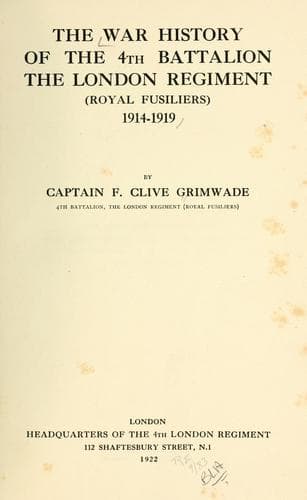
The War History of the 4th Battalion, the London Regiment (Royal Fusiliers), 1914-1919Grimwade, F. Clive
History
The War History of the 4th Battalion, the London Regiment (Royal Fusiliers), 1914-1919
Grimwade, F. Clive
Great Britain. Army. London Regiment. 4th (City of London) Battalion; World War, 1914-1918 -- Regimental histories -- Great Britain
SIRHIND BRIGADE--Brig.-Gen. W. R. Walker, V.C.
1st Highland Light Infantry.
4th King's Liverpools.
15th Ludhiana Sikhs.
1/1st Gurkha Rifles.
1/4th Gurkha Rifles.
FEROZEPORE BRIGADE--Brig.-Gen. R. G. Egerton, C.B.
1st Connaught Rangers.
1/4th Londons.
9th Bhopals.
57th Wilde's Rifles (F.F.).
129th Baluchis (Duke of Connaught's Own).
During the months of December and January the Indian Corps had been
heavily engaged in a local operation which had raged with terrific
intensity between the small village of Givenchy and the extreme right
of our line; but our struggles to press forward along the canal to La
Bassée had been checked by a particularly vigorous defence on the part
of the enemy. The casualties suffered by the Brigades of the Indian
Corps in the fighting had been so severe that it was necessary to
withdraw some of them for a time from the line for the purpose of rest
and reorganisation.
On joining its Brigade the strength of the 1/4th Londons was 25
officers and 828 other ranks. The Battalion was fortunate in being
posted to the Division at this juncture as it had an opportunity
before going into action of becoming acquainted with its neighbouring
battalions with whom it was destined to share the fortunes of war
during the ensuing eleven months, and of gaining some insight into the
ancient, but at that date recently revived, sciences of bombing and
trench mortar work. And here let us remark for the benefit of those
members of the Battalion who joined the Service at a later stage and
found Mills Bombs and the Stokes Mortar ready for their use, that
in February 1915 the only bombs in use were those of the "jam-tin"
variety, that is to say, were roughly constructed out of old tins by
the troops who were to use them, filled with explosives, plugged with
clay, and fused with ordinary time fuse which had to be ignited before
the bomb was thrown; while the trench mortar of the day is perhaps best
described as a glorified rainwater pipe bound with copper wire, and
which threw a "jam-tin" bomb and was quite as dangerous to the team
which manned it as to the Germans.
With their unfailing adaptability to circumstances the men of the
Battalion rapidly became friends with the Indian troops whom they
held in the greatest admiration. The Gurkhas in particular seemed
to exercise an irresistible attraction for the men of London, who
were especially impressed with the Gurkhas' playful way of throwing
their murderous Kukri knives. Indeed, to such lengths did this
admiration--which took the form of imitation--lead them that a
Battalion order was very quickly necessary to the effect that "the
game known as 'Gurkhas' played with unsheathed bayonets must cease
forthwith!"
Public-domain text, read in full here on John Shaqi.
Reviews
Reviews
No reviews yet
Be the first to share your thoughts on this work.
Join the Discussion
Join the discussion
Sign in to leave a comment or review.
Sign InorCreate an account