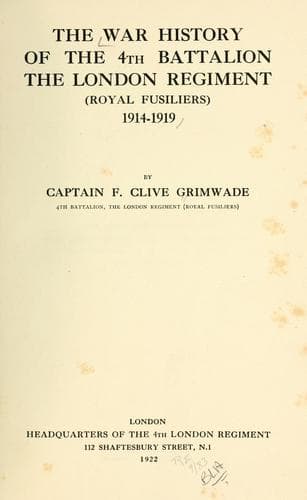
The War History of the 4th Battalion, the London Regiment (Royal Fusiliers), 1914-1919Grimwade, F. Clive
History
The War History of the 4th Battalion, the London Regiment (Royal Fusiliers), 1914-1919
Grimwade, F. Clive
Great Britain. Army. London Regiment. 4th (City of London) Battalion; World War, 1914-1918 -- Regimental histories -- Great Britain
Throughout this period the weather was intensely cold and several falls
of snow occurred. The billets were passably good, however, and the
Battalion's bill of health remained clean.
The Battalion was unfortunate at this period in losing Sergeant-Major
Dudley, who had done excellent work since mobilisation and now left for
a commission in the Royal Fusiliers. He was killed a fortnight after
joining his regiment. His duties were taken by Col.-Sergt. Instr. M.
Harris, who filled this important position with success for nearly
three years.
On the 22nd February the undermentioned officers, being the first
reinforcement received by the Battalion, joined as follows:
Lieuts. F. A. Coffin, H. M. Lorden, D. J. Leonard, and A. D. Coates.
It is now necessary for a moment to look at the course which events
were taking on the wide field of the Western Theatre.
At the period with which we are dealing, the Front held by the British
troops extended from the Béthune-La Bassée Road, on the right to just
north of the Ypres Salient on the left, and General Headquarters
(Field-Marshal Sir John French in command) were at St Omer. The
British troops were divided into two Armies, of which the First Army
under Sir Douglas Haig, consisting of the I Corps (Gough), IV Corps
(Rawlinson), and Indian Corps (Willcocks), held the right or southern
end of the line; the left being entrusted to the Second Army (Sir H.
Smith-Dorrien), which comprised the II Corps (Fergusson), the III Corps
(Pulteney), and the V Corps (Plumer).
The moving warfare of the autumn of 1914, which had ended by the
opposing armies gradually extending their flanks until the sea
was reached and had culminated in the First Battle of Ypres in
October--November 1914, had given way to a siege warfare in which
the belligerents were confined in continuous lines of trenches which
were gradually being more heavily fortified. After the force of the
German drive toward Ypres had exhausted itself, a lull in active
operations ensued, hostilities flaring up here and there along the
line in the shape of minor operations of terrible intensity, in which
the possession of a few yards of ground was contested with ferocity by
both sides. In the intervals between these small struggles, however,
the battle line had been comparatively quiet during the winter months,
and not materially changed, the nett result being perhaps a slight gain
of ground to the British at the southern end of the line, which was
balanced by a tendency to lose ground in the north.
Public-domain text, read in full here on John Shaqi.
Reviews
Reviews
No reviews yet
Be the first to share your thoughts on this work.
Join the Discussion
Join the discussion
Sign in to leave a comment or review.
Sign InorCreate an account