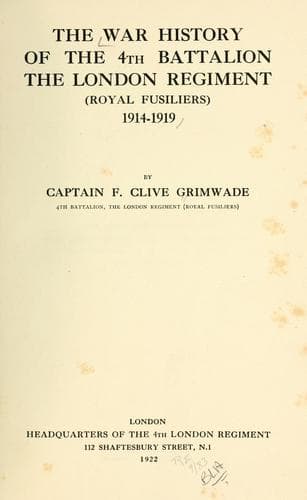
The War History of the 4th Battalion, the London Regiment (Royal Fusiliers), 1914-1919Grimwade, F. Clive
History
The War History of the 4th Battalion, the London Regiment (Royal Fusiliers), 1914-1919
Grimwade, F. Clive
Great Britain. Army. London Regiment. 4th (City of London) Battalion; World War, 1914-1918 -- Regimental histories -- Great Britain
Since the bitter struggle at Ypres in November 1914, the enemy had, in
the opinion of Sir John French, shown certain signs of weakening on the
Western Front, and this was attributed by him to the success which was
attending the Russian offensive in East Prussia, and to the consequent
withdrawal of German troops from the West. In order to assist our
Russian Allies as far as possible it was necessary to have resort to
active operations with the main object of holding as many of the German
reserves as possible in the West, and efforts to this end were already
being made by the French at Arras and in Champagne.
The ravages caused during the winter trench warfare by sickness and
"trench-foot," which had had especially disastrous effects on those
regular divisions composed of troops withdrawn from tropical garrisons,
rendered necessary the early cultivation of a vigorous offensive
spirit, and these combined considerations led Sir John French to the
decision to take the offensive as soon as the condition of the ground
in Flanders should afford such an undertaking a reasonable prospect
of success. By the beginning of March the conditions were considered
sufficiently favourable, and the terrain selected for the proposed
offensive was the German positions opposed to the First Army and
defending the lower slopes of the Aubers Ridge.
The objective of the First Army's attack was the advancement of our
line to the high ground about Illies and Hermies as a prelude to the
occupation of La Bassée, and this involved as a first local objective
the capture of the village of Neuve Chapelle. The Aubers Ridge is a
strongly marked hill feature, which runs in a south-westerly direction
from Lille until it loses itself in the marshlands in the neighbourhood
of La Bassée. Neuve Chapelle, which had already changed hands several
times in the fighting of the previous autumn, is a small village, the
immediate surroundings of which are much intersected with orchards and
fences, about 1000 yards from the lowest slopes of the Ridge, which,
immediately opposite to it, are covered by a considerable wood called
the Bois du Biez.
The German defensive position skirted in front (or to the north-west)
of Neuve Chapelle and then making a sharp turn southwards, followed
the line of the Estaires-La Bassée Road, for some 600 yards, from its
junction with Foresters Lane (Rue des Berceaux) to its junction with
the Rue du Bois, where once more turning slightly to the west it left
the hamlet of Richebourg L'Avoué in the British lines, and finally made
a wide sweep once more to the south in the direction of Festubert (see
Map No. 1). The front of attack allotted to the Indian Corps was that
part which followed the alignment of the La Bassée road between Rue
du Bois and Foresters Lane, the actual capture of the greater part of
Neuve Chapelle being entrusted to the 8th Division.
Public-domain text, read in full here on John Shaqi.
Reviews
Reviews
No reviews yet
Be the first to share your thoughts on this work.
Join the Discussion
Join the discussion
Sign in to leave a comment or review.
Sign InorCreate an account