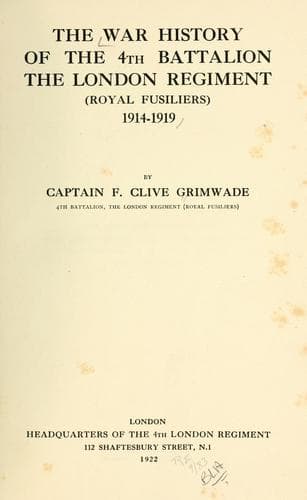
The War History of the 4th Battalion, the London Regiment (Royal Fusiliers), 1914-1919Grimwade, F. Clive
History
The War History of the 4th Battalion, the London Regiment (Royal Fusiliers), 1914-1919
Grimwade, F. Clive
Great Britain. Army. London Regiment. 4th (City of London) Battalion; World War, 1914-1918 -- Regimental histories -- Great Britain
The attack was to be preceded by a heavy artillery bombardment, which
on the Corps front would be conducted by the divisional artillery of
both the Lahore and Meerut Divisions and the Corps heavy artillery, and
this was to be directed towards destroying the enemy's front trenches
and entanglements and certain strong posts, the searching of the
Bois du Biez, in order to disperse the concentration of the enemy's
counter-attack troops, and finally the building up of a "curtain of
fire" (subsequently though less descriptively termed a "barrage") east
of the captured positions, with the object of assisting the work of
consolidating them.
The direction of the Indian Corps' attack being almost easterly
converged towards that of the IV Corps on their left (this being
south-easterly), and it was, therefore, necessary after the first
German positions had been carried and touch with the IV Corps secured,
to swing the direction of attack round more to the south, and to
establish a fire position facing south in order to guard against the
danger of a German flanking counter-attack from that quarter. The
position selected for this was a German sap, which had been thrown out
from the enemy lines towards the British strong point, Port Arthur, at
the corner of La Bassée Road and Rue du Bois.
The troops holding the line of the Rue du Bois front, outside the limit
of the general attack, would thus be responsible for the defence of the
Indian right flank. It was hoped that the first bound would carry our
line forward to the old II Corps line first occupied by Smith-Dorrien's
troops in October 1914, east of Neuve Chapelle village.
The assaulting troops detailed for this task were the Gharwal and Dehra
Dun Brigades of the Meerut Division, the Bareilly Brigade being in
close support; while the Lahore Division (less artillery) was placed in
Corps reserve, the Ferozepore Brigade being allotted to Army Reserve.
In accordance with these orders the Ferozepore Brigade moved forward
from Ham-en-Artois to the Zelobes area on the 7th March, the 4th
Londons marching to Calonne-sur-Lys about eight miles north-west of
Neuve Chapelle, where it remained in billets in a constant state of
readiness to move. On the eve of the outbreak of our offensive the
order was relaxed to one of readiness to move at twelve hours' notice.
On the 10th March Lieut.-Col. Botterill was granted seven days' leave
of absence on urgent private affairs, and command of the Battalion
devolved temporarily on Major L. T. Burnett, who remained in command
until after the termination of the Neuve Chapelle operations.
In addition to the Brigades of the Meerut Division already mentioned,
on the right of the line, the troops detailed for the assault comprised
the 25th Brigade of the 8th Division opposite Neuve Chapelle village,
with the 23rd Brigade of the same Division on the extreme left.
Public-domain text, read in full here on John Shaqi.
Reviews
Reviews
No reviews yet
Be the first to share your thoughts on this work.
Join the Discussion
Join the discussion
Sign in to leave a comment or review.
Sign InorCreate an account