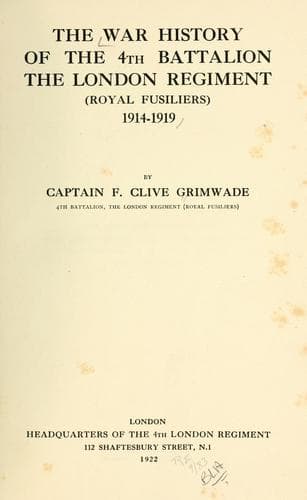
The War History of the 4th Battalion, the London Regiment (Royal Fusiliers), 1914-1919Grimwade, F. Clive
History
The War History of the 4th Battalion, the London Regiment (Royal Fusiliers), 1914-1919
Grimwade, F. Clive
Great Britain. Army. London Regiment. 4th (City of London) Battalion; World War, 1914-1918 -- Regimental histories -- Great Britain
An enormous concentration of artillery had been quietly effected on
this front, including many of our newly arrived heavy batteries, and
at 7.30 a.m. on the 10th March, some 300 guns opened a devastating
bombardment on the German trenches along the frontage of attack.
The severity of this bombardment was unprecedented. Trenches were
obliterated, machine-guns and Germans were literally blown into the
air, and so dazed were the enemy by the appalling ordeal that our men
were able to stand on their parapets to watch the inferno in front
of them. At 8.5 a.m. the range of the guns was lengthened on to the
enemy's support trenches and our assaulting columns dashed forward.
The Indians and the 25th Brigade met with little resistance, but the
23rd Brigade on the left found itself faced with a practically unbroken
wire entanglement, from beyond which a deadly fire was poured into it
by the enemy machine-guns. By 8.35 a.m. the right and centre brigades
had effected a lodgment in the village, but the 23rd, being still held
up and suffering terrible losses, the 25th Brigade swung to its left
and turned the flank of the German troops who were opposing the 23rd.
By this means our left was able to advance and by 11 a.m. the village
of Neuve Chapelle was completely in our hands, and consolidation of
the ground won was begun under cover of our artillery barrage, which
effectually carried out its task of preventing the enemy bringing
forward reinforcements for a counter-attack.
The street fighting, however, had resulted in considerable
disorganisation of units, so that valuable hours were lost in the
necessary reorganisation, and it was not until 3.30 p.m. that the
advance could be resumed. The attack so far had proved--as was
intended--a complete surprise, and the enemy's resistance seems to have
been paralysed except on the extreme left where our troops were still
under heavy fire.
The only local counter-attack which developed during the morning of the
10th was on the extreme right of the attack, where the enemy succeeded
along the Rue du Bois in temporarily ejecting the Indian troops from
the captured trenches, and in effecting a strong lodgment in the
Orchard Trench in front of Richebourg L'Avoué. During the morning the
Jullundur and Sirhind Brigades moved forward to Richebourg St Vaast and
Vieille Chapelle respectively.
Public-domain text, read in full here on John Shaqi.
Reviews
Reviews
No reviews yet
Be the first to share your thoughts on this work.
Join the Discussion
Join the discussion
Sign in to leave a comment or review.
Sign InorCreate an account