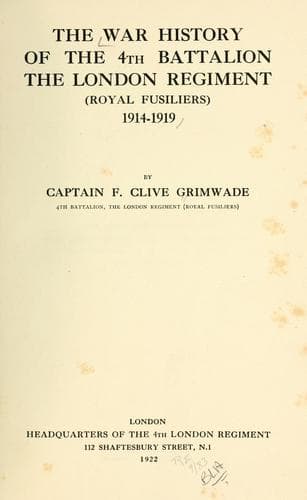
The War History of the 4th Battalion, the London Regiment (Royal Fusiliers), 1914-1919Grimwade, F. Clive
History
The War History of the 4th Battalion, the London Regiment (Royal Fusiliers), 1914-1919
Grimwade, F. Clive
Great Britain. Army. London Regiment. 4th (City of London) Battalion; World War, 1914-1918 -- Regimental histories -- Great Britain
The afternoon advance was made on the right by the Dehra Dun Brigade,
supported by the Jullundur Brigade of the Lahore Division, and the
objective assigned to it was the Bois du Biez. Between Neuve Chapelle
and the wood runs the little Rivière des Layes, and at a point where
this stream is spanned by a road bridge the enemy had established a
strong machine-gun post. The Indians made a gallant advance over 1000
yards of open country, and succeeded in penetrating the wood, but their
line was enfiladed by the machine-guns on the bridge and they were
unable to hold the line of their furthest advance. On the left the
attack was renewed by the 25th and 24th Brigades, the hard-hit 23rd
being held back, their objective being the cluster of houses at Moulin
de Pietre, about a mile east of Neuve Chapelle; but their efforts also
were frustrated by the machine-guns on the bridge, which our artillery
was unable to dislodge. Further left still the front of attack had been
extended and the 21st Brigade (Watts) of the 7th Division was also
directed on Pietre; but in its advance encountered a line of undamaged
German trenches which effectually barred its efforts to progress.
The position, therefore, when darkness intervened was that an average
advance of over a thousand yards had been gained and held, while
practically no effort had been made by the enemy to regain possession
of the lost ground.
Preparations were made for a renewal of the advance on the following
day, but the 11th dawned misty and the day proved to be one of
equilibrium. A further advance was, attempted but the mist rendered
aircraft observation impossible and artillery co-operation with the
infantry extremely difficult owing to the constant breaking of our
forward lines of communication by the enemy shell fire. Our troops,
therefore, clung to their positions opposite the Bois du Biez and
Pietre under a murderous shell fire which caused many casualties; while
the enemy, by a stroke of ill fortune, was accorded a for him lucky
respite, in which he was able to prepare his counter-attack.
On the evening of the 11th the exhaustion of the troops after two days'
fighting rendered a relief desirable, as it was hoped that weather
conditions would favour a prosecution of the offensive on the next day.
The Meerut Division consequently handed over its newly won positions
to the Lahore Division, the Dehra Dun Brigade being replaced by the
Sirhind Brigade, while arrangements were completed for relieving the
Gharwal Brigade on the night of the 12th/13th by the Ferozepore Brigade.
Public-domain text, read in full here on John Shaqi.
Reviews
Reviews
No reviews yet
Be the first to share your thoughts on this work.
Join the Discussion
Join the discussion
Sign in to leave a comment or review.
Sign InorCreate an account