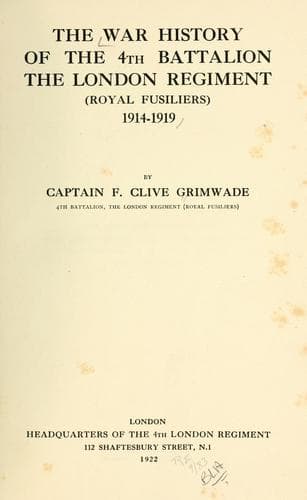
The War History of the 4th Battalion, the London Regiment (Royal Fusiliers), 1914-1919 — John Shaqi
The War History of the 4th Battalion, the London Regiment (Royal Fusiliers), 1914-1919Grimwade, F. Clive
History
The War History of the 4th Battalion, the London Regiment (Royal Fusiliers), 1914-1919
Grimwade, F. Clive
Great Britain. Army. London Regiment. 4th (City of London) Battalion; World War, 1914-1918 -- Regimental histories -- Great Britain
The same evening the 4th London moved at 6 p.m. from Calonne to Lestrem
where it arrived at midnight and went into billets. Its stay there,
however, was short as within two hours it was turned out in order to
move further forward to Lacouture, about four miles west of Neuve
Chapelle, reaching there about 7.30 a.m. on the 12th March. Similar
forward moves were made by the remainder of the Brigade in view of its
impending occupation of the line.
When the 4th Londons reached Lacouture the village was under shell fire
from the enemy's heavy guns and the behaviour of all ranks under fire
for the first time was highly commendable. But here also the hopes
of rest on which the thoughts of all had been centred far more than
on the German shells, were dashed, for almost immediately on arrival
the Battalion received fresh orders to move forward to Richebourg St
Vaast, in which village Brigade headquarters were then operating. The
exhaustion of all ranks on arrival was considerable as the Battalion
had been almost continuously on the move in full marching order for
about eighteen hours. Richebourg was a village of some importance and
a considerable number of our heavy batteries supporting the Neuve
Chapelle attack were stationed in its vicinity, with the result that it
received a generous share of the enemy's counter-battery bombardment
and also a good deal of attention due, apparently, to the prominence of
its church tower, to the existence of which the Germans objected.
Here at last the Battalion was allotted billets in which it remained
until about 7 p.m., being under heavy shell fire the whole time and
sustaining its first battle casualties of seven men wounded.
The mist continued during the 12th and our main operation could not
be pursued. The hostile shell fire increased in intensity, but the
Germans were equally with ourselves embarrassed by the difficulties of
accurate observation and their bombardments were not very disastrous
to us. Local advances were attempted by our troops in various parts
of the line and the houses at Pietre were actually reached by the
Guards of the 20th Brigade, but the ground gained was heavily swept by
hostile fire and could not be retained. All day counter-attacks in mass
formation were attempted by the Germans, and costly as the day was to
us, our casualties must have been far exceeded by theirs, their ranks
being literally mown down by our rifle, machine-gun and shrapnel fire.
By dusk the enemy's attempts had exhausted themselves and for the first
time in the war the Germans gave up attempts to recapture ground they
had lost.
Public-domain text, read in full here on John Shaqi.
Reviews
Reviews
No reviews yet
Be the first to share your thoughts on this work.
Join the Discussion
Join the discussion
Sign in to leave a comment or review.
Sign InorCreate an account