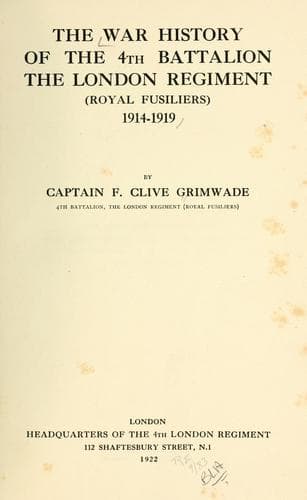
The War History of the 4th Battalion, the London Regiment (Royal Fusiliers), 1914-1919Grimwade, F. Clive
History
The War History of the 4th Battalion, the London Regiment (Royal Fusiliers), 1914-1919
Grimwade, F. Clive
Great Britain. Army. London Regiment. 4th (City of London) Battalion; World War, 1914-1918 -- Regimental histories -- Great Britain
As it had been hoped that the 12th would witness the continuance of
our successes it had been impossible to arrange beforehand the details
of the relief of the Gharwal Brigade by the Ferozepore Brigade until
the result of the intended operations should be known, and it was not,
therefore, until late in the afternoon that the Brigade received orders
to move forward at once in order to take part in an attack that evening
on the Bois du Biez, which position it was proposed to carry at all
costs. For this operation the 41st Dogras of the Bareilly Brigade, then
in the trenches, were to be lent to the Brigade and relieved in their
position in line by the 4th Londons. This relief, however, could not
be effected in time to enable the 41st Dogras to join the Ferozepore
Brigade, which consequently advanced short of one battalion.
The Brigade was not assembled in front of Neuve Chapelle until darkness
had fallen, and in order to allow time for the necessary dispositions
to be made, General Egerton, who for this operation commanded not only
the Ferozepore, but also the Jullundur and Sirhind Brigades, arranged
for the attack to commence at 10.30 p.m. At 9.30 p.m., however, orders
were received cancelling the attack and indicating that the offensive
had closed, and the Brigade returned to billets in Vieille Chapelle and
Lacouture.
Meanwhile the 4th Londons proceeded with the relief of the 41st Dogras,
and although they occupied the line only for a few hours, perhaps we
may be pardoned for a rather more detailed record of the night's work
than the importance of the operation warrants in view of the fact that
this was the first tour of duty done by the Battalion in trenches.
The sector to be occupied lay at an interval of about 300 yards from
the right limit of the Neuve Chapelle attack as already described,
and consisted of a frontage of some 400 yards, in front of the Rue du
Bois. The line in this part did not consist of a continuous line of
trenches. In the first place, the ground here, as for miles in each
direction, was too waterlogged to admit of a trench being dug, and the
defences, therefore, consisted of a breastwork built up above ground
level, and in most parts of this sector the breastwork did not exceed
three feet in height and was entirely without parados. As a result,
moreover, of the recent fighting the defensive line consisted rather of
a series of short breastworks with gaps between them which could only
be crossed under cover of darkness. Communication trenches to the rear
were non-existent and the breastwork had to be approached from the Rue
du Bois, to which it ran parallel at a distance of about fifty yards,
"overland." It may be of interest to those who served in this area
with the regiment in the winter of 1916/17 to state that this feeble
breastwork was almost in the position of the support line subsequently
known as Guards' Trench.
[Illustration: NEUVE CHAPELLE--RICHEBOURG L'AVOUÉ]
Public-domain text, read in full here on John Shaqi.
Reviews
Reviews
No reviews yet
Be the first to share your thoughts on this work.
Join the Discussion
Join the discussion
Sign in to leave a comment or review.
Sign InorCreate an account