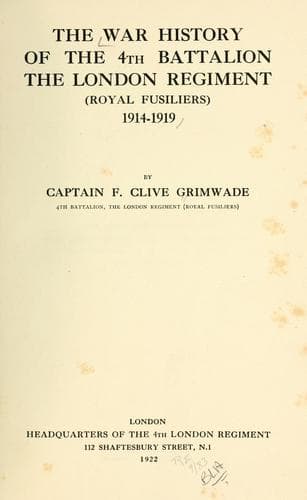
The War History of the 4th Battalion, the London Regiment (Royal Fusiliers), 1914-1919Grimwade, F. Clive
History
The War History of the 4th Battalion, the London Regiment (Royal Fusiliers), 1914-1919
Grimwade, F. Clive
Great Britain. Army. London Regiment. 4th (City of London) Battalion; World War, 1914-1918 -- Regimental histories -- Great Britain
This position perhaps was not an ideal one for the first introduction
of a raw Battalion to trench warfare, and the situation was not
improved by the exhaustion of the men or the fact that the Rue du
Bois was subject to a great deal of heavy shelling which had not died
down since the German counter-attacks of the day, but which continued
through the night. The Battalion moved forward by platoons past Windy
Corner, where it came under a heavy burst of shrapnel, and Edward Road,
skirting behind the ruined factory at the corner of the Rue du Bois,
and led by Indian guides, whose vague acquaintance with the language
of London did not assist matters to any appreciable extent. Be it
remembered also that no maps had been issued and no reconnaissance
of the line had been possible to any company officer. However, the
Battalion succeeded in occupying its breastwork and remained there
during the night, somewhat isolated as touch with the units on its
flanks was difficult to maintain owing to the breaks in the line, and
all ranks acquitted themselves in an exemplary manner. The shrapnel and
machine-gun fire maintained by the Germans during the night cost a few
casualties, amounting to 14 N.C.O.'s and men wounded. In addition to
these was 2/Lieut. A. R. Moore, who was hit in the leg on the way up to
the line. This officer, however, stuck to his duty and remained with
his platoon until after relief of the Battalion the next morning. He
was awarded the Military Cross for his gallant conduct.
The Ferozepore Brigade attack not having materialised, the 41st Dogras
returned to the trenches, and before daybreak the 4th Londons were
relieved and withdrew to billets in Vieille Chapelle.
With these incidents ended the battle of Neuve Chapelle in which,
although the gain of ground was much less than had been hoped for,
yet some solid success had been achieved. Our line had been carried
forward for about 1000 yards on a front of about two miles, and the
prisoners captured amounted to 1650 all ranks. The British casualties
had reached the serious total of 12,811, but the enemy's far exceeded
this number. The outstanding result of the action, however, was an
immense accession of moral strength to the British troops, for it had
been clearly established that where we could meet the Germans on terms
of equality in men and material, we were able to beat them, and the
confirmation of this, supplied by the battle of Neuve Chapelle, sent a
thrill of triumph in the hearts of our men all along the line.
On the night 13/14 March, the Ferozepore Brigade relieved the Bareilly
Brigade on the Rue du Bois, the front line being occupied by the 57th
Rifles, 129th Baluchis and 1st Connaught Rangers, the 4th Londons
moving to Richebourg St Vaast in Brigade reserve.
Public-domain text, read in full here on John Shaqi.
Reviews
Reviews
No reviews yet
Be the first to share your thoughts on this work.
Join the Discussion
Join the discussion
Sign in to leave a comment or review.
Sign InorCreate an account