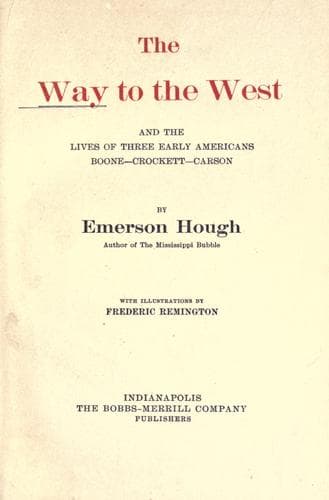
The Way to the West, and the Lives of Three Early Americans: Boone—Crockett—Carson — John Shaqi
The Way to the West, and the Lives of Three Early Americans: Boone—Crockett—CarsonHough, Emerson
History
The Way to the West, and the Lives of Three Early Americans: Boone—Crockett—Carson
Hough, Emerson
Boone, Daniel, 1734-1820; Carson Kit, 1809-1868; Crockett, Davy, 1786-1836; Mississippi River Valley -- History; West (U.S.) -- History
Here is that fairy ship of the wilderness, the birch-bark canoe, the
first craft of America, antedating even the arrival of the white man. It
is the ship of risk and of adventure, belonging by right to him who goes
far and travels light, who is careless of his home coming. It is a boat
that now carries the voyager, and now is carried by him. It is a
great-hearted craft. You shall take it upon your shoulders, and carry it
a mile across the land trail, without needing to set it down; but when
you place it on the water it in turn will carry you and your fellow, and
yet another, and your household goods of the wilderness up to five times
your weight.
Freakish as a woman, as easily unsettled, yet if you be master it shall
take you over combing waves, and down yeasty rapids and against steady
current, until finally you shall find yourself utterly apart from the
familiar haunts of man, about you only the wilderness, the unadventured.
This is the ship of the wilderness, the fairy ship, the ship of heroes.
To-day it is passing away. With it goes great store of romance and
adventure.
The red man taught the white man how to build and how to use this boat.
He taught how to cut the long strips of toughest bark from the
birch-tree, prying it off with sharpened pole or driven wooden wedge. He
showed how to build the frame of the boat on the ground, or in a long
hole dug in the ground, where stakes hold fast the curves of the
gunwales, between which are later forced the steamed splints that serve
as ribs and as protection for the fragile skin, soaked soft and pliable,
which is presently laid on the frame of gunwale and rib and bottom
splint. This covering of bark is sewn together with the thread of the
forest, fiber of swamp conifers—“wautp,” the Indians of the North call
this thread.
Then over the seams is run the melted pitch and resin taken from the
woods. The edges of the bark skin are made fast at the gunwales, the
sharply bent bows are guarded carefully from cracks where the straining
comes, and the narrow thwarts, wide as your three fingers, are lashed
in, serving as brace and as all the seat you shall find when weary from
kneeling. The fresh bark is clean and sweet upon the new-made ship, the
smell of the resin is clean. Each line of the boat is full of spirit and
grace and beauty.
Public-domain text, read in full here on John Shaqi.
Reviews
Reviews
No reviews yet
Be the first to share your thoughts on this work.
Join the Discussion
Join the discussion
Sign in to leave a comment or review.
Sign InorCreate an account