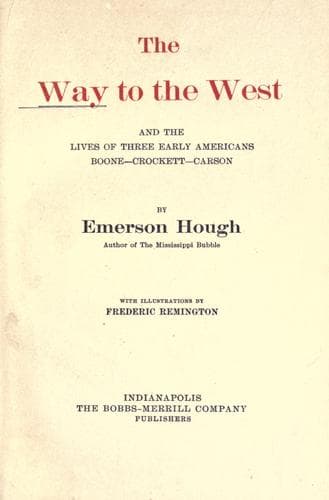
The Way to the West, and the Lives of Three Early Americans: Boone—Crockett—Carson — John Shaqi
The Way to the West, and the Lives of Three Early Americans: Boone—Crockett—CarsonHough, Emerson
History
The Way to the West, and the Lives of Three Early Americans: Boone—Crockett—Carson
Hough, Emerson
Boone, Daniel, 1734-1820; Carson Kit, 1809-1868; Crockett, Davy, 1786-1836; Mississippi River Valley -- History; West (U.S.) -- History
The builder turns it over, and where he finds a bubble in the pitching
of a seam he bends down and puts his lips to it, sucking in his breath,
to find if air comes through. So he tests it, well and thoroughly,
mending and patching slowly and carefully, until at last it pleases him
throughout. And then he places his new-made ship on the water, where it
sits high and light, spinning and turning at its tether, never still for
an instant, but shifting like a wild duck under the willows, responsive
to the least breath of the passing airs. It is eager to go on. It will
go far, in its life of a year or two. If it gets a wound from the rocks,
or from the clumsiness of the tyro that drives it upon the beach instead
of anchoring it free, then it is easily mended by a strip of bark and
some forest pitch. When at last it loses its youth, and cracks or soaks
in water so freely that it takes too long to dry it at the noonday
pipe-smoking, then it is not so difficult to build another in the
forest.
The canoe is as the ax and the rifle, an agent economical, capable of
great results in return for small expenditure of energy. It is American.
There was much to do, far to go. It was thus because America existed as
it did.
No craft has been found easier of propulsion to one knowing the art of
the paddle. The voyager makes his paddle about as long as his rifle, up
to his chin in length. He paddles with the blade always on one side of
the canoe. As the blade is withdrawn from the backward stroke, it is
turned slightly in the water, so that the course of the bow is still
held straight. If he would approach a landing sidewise with his boat, he
makes his paddle describe short half curves, back and forth, and the
little boat follows the paddle obediently. The advance of the canoe is
light, silent, spirit-like. It is full of mystery, this boat. Yet it is
kind to those who know it, as is the wilderness and as are all its
creatures.
This is the boat of the northern traveler, the voyager of the upper
ways. In the South, where the birch does not grow in proper dimensions,
the bark of the elm has on occasion served to make a small craft. In
different parts of the North, too, the birch canoe takes different
shapes. In the northeast the Abenakis made it long and with little rake,
with low bow and stern and with bottom swelling outward safely under the
tumble-home,—this stable model serving for the strong streams of the
forested regions of the North. Far to the west, where roll the great
inland lakes, the Ojibways made their boats higher at bow and stern,
wider of beam, shorter, rounder of bottom, all the better fitted for
short and choppy waves.
Public-domain text, read in full here on John Shaqi.
Reviews
Reviews
No reviews yet
Be the first to share your thoughts on this work.
Join the Discussion
Join the discussion
Sign in to leave a comment or review.
Sign InorCreate an account