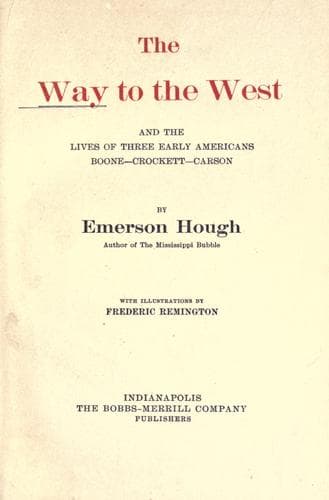
The Way to the West, and the Lives of Three Early Americans: Boone—Crockett—CarsonHough, Emerson
History
The Way to the West, and the Lives of Three Early Americans: Boone—Crockett—Carson
Hough, Emerson
Boone, Daniel, 1734-1820; Carson Kit, 1809-1868; Crockett, Davy, 1786-1836; Mississippi River Valley -- History; West (U.S.) -- History
His progress was bitterly contested by the Indian savages all the way
cross the American continent, but they perished before this engine of
civilization, which served its purpose across the timbered Appalachians,
down the watershed to the Mississippi, up the long and winding streams
of the western lands, over the Rockies, and down the slopes of the
Sierras to the farther sea. Had it never known change it had not been
American. An ax is an ax, because a tree is a tree, whether in the
Alleghanies or the Rockies; but the rifle met in time different
conditions. The great plains furnished larger game animals, and demanded
longer range in arms, so that in time the rifle shot a heavier ball.
When the feverish intensity of American life had asked yet more haste,
there came the repeating rifle, firing rapidly a number of shots, an
invention now used all over the earth. In time there came also the
revolving pistol, rapid, destructive, American. These things had not to
do with the early west-bound man, this wilderness traveler, himself
perforce almost savage, shod with moccasins, wearing the fringed hide
tunic that was never in the designs of Providence intended for any
unmanly man, and that fits ill to-day the figure of any round-paunched
city dweller. Feather or plume he did not wear in his hat, for such
things pertained rather to the hired voyager than to the independent
home builder. Ornamentation was foreign to his garb and to his weaponry.
He had much to do. The way was hard. No matter how he must travel, this
long rifle was with him. At his belt, in the little bag of buckskin,
were the bullets in their stoppered pouch, the cleaning worm, the extra
flint or two, the awl for mending shoon or clothing.
So were equipped the early Americans, gaunt, keen, tireless, that
marched to meet the invading forces at the battle of New Orleans; and
when the officers of the British army, on the day after that stricken
field, found half their dead shot between the eyes, they knew they could
lead their troops no more against such weaponry and such weapon bearers.
The rifle had won the West, and it would hold it fast.
-----
Footnote 1:
In a careful test an old squirrel-rifle, for three generations in the
author’s family, and now nearly one hundred years old, was fired five
times, at a distance of 60 yards, and the point of the finger would
cover all five of the balls, which made practically but one ragged
hole. The author’s father handled the old weapon on this occasion.
Again, in the author’s hands, it shot out in succession the spots or
pips of a playing card, the ten of clubs, at such distance as left the
spots only clearly distinguishable. This piece was altered from flint
lock to pill-percussion lock, and later to the percussion cap lock.
CHAPTER III
THE AMERICAN BOAT
Public-domain text, read in full here on John Shaqi.
Reviews
Reviews
No reviews yet
Be the first to share your thoughts on this work.
Join the Discussion
Join the discussion
Sign in to leave a comment or review.
Sign InorCreate an account