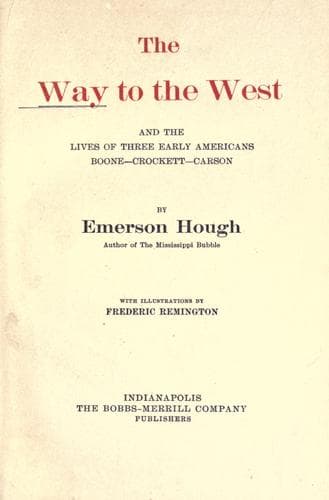
The Way to the West, and the Lives of Three Early Americans: Boone—Crockett—CarsonHough, Emerson
History
The Way to the West, and the Lives of Three Early Americans: Boone—Crockett—Carson
Hough, Emerson
Boone, Daniel, 1734-1820; Carson Kit, 1809-1868; Crockett, Davy, 1786-1836; Mississippi River Valley -- History; West (U.S.) -- History
Then, under the white fur traders’ tutelage, there were made great ships
of birch-bark, the canot du Nord of the Hudson Bay trade, such as came
down with rich burdens of furs when the brigades started down-stream to
the markets; or yet the greater canot du maitre once used on the Great
Lakes, a craft that needed a dozen to a dozen and a half paddles for its
propulsion. Again, at the heads of the far off Northwestern streams
there were canoes so small as to carry but a single person, propelled by
a pair of sticks, one in each hand of the occupant, the points of these
hand-sticks pushing against the bottom of the stream. But ever this ship
of the wilderness was so contrived that its crew could drive it by water
or carry it by land.
Thus were the portages mastered, thus did the man with small gear to
hinder him get out from home, westward into the wilderness. Down stream
or up stream, this boat went far. Paddle or sail or shodden pole served
for the wanderer before the trails were made, and before the boats of
the white settlers followed where the savage red men and scarcely less
savage white adventurers had found the way.
There were other boats for the early traveler, and these were employed
by those that had crossed the Alleghanies on foot and would fare farther
westward. The dugout, made of the sycamore or sassafras log, ten to
twenty feet in length, narrow, unstable, thick-skinned and a bit clumsy,
was good enough for one pushing on down-stream, or prowling about in
sluggish, silent bayous. This was the boat of the South in the early
days. Soon the great flat-boat succeeded it for those that traveled with
family goods or in large parties. The wooden boats came later, the
flat-boat after the dugout, the keel-boat but following the far trail of
the birch-bark to the upper ways, or perchance passing, slipping
down-stream, the frail hide coracle of the hunter that had ventured
unaccompanied far into unknown lands.
Above all things in these early days must compactness and lightness be
studied. This American traveler was poor in the goods of this world; his
possessions made small bulk. This ax made him bivouac or castle, or
helped him make raft or canoe. This rifle gave him food and clothing. He
walked westward to the westward flowing streams, and there this light
craft, dancing, beckoning, alluring, invited him yet on and on,
proffering him carriage for his scanty store, offering obedience to him
who was the master of the wilderness, of its alluring secrets and its
immeasurable resources.
CHAPTER IV
THE AMERICAN HORSE
Observe here a creature, a dumb brute, that has saved some centuries of
time. Indeed, without this American horse, the American civilization
perhaps could never have been. Without the ax, the rifle, the boat and
the horse there could have been no West.
Public-domain text, read in full here on John Shaqi.
Reviews
Reviews
No reviews yet
Be the first to share your thoughts on this work.
Join the Discussion
Join the discussion
Sign in to leave a comment or review.
Sign InorCreate an account