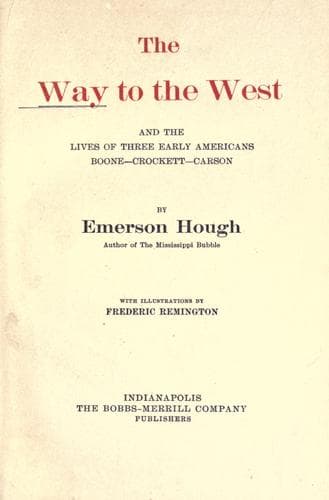
The Way to the West, and the Lives of Three Early Americans: Boone—Crockett—CarsonHough, Emerson
History
The Way to the West, and the Lives of Three Early Americans: Boone—Crockett—Carson
Hough, Emerson
Boone, Daniel, 1734-1820; Carson Kit, 1809-1868; Crockett, Davy, 1786-1836; Mississippi River Valley -- History; West (U.S.) -- History
To-day we would in some measure dispense with the horse, but in the
early times no part of man’s possessions was more indispensable. This
animal was not then quite as we find him to-day in the older settled
portions of the country. In some of our wilder regions we can still see
him somewhat as he once was, rough, wiry, hardy, capable of great
endeavor, easily supported upon the country over which he passed.
Naturally the early west-bound traveler could not take with him food for
his horse, and the latter must be quite independent of grain. Corn,
exceedingly difficult to raise, was for the master alone. The horse must
live on grass food, and find it where he stopped at night. During the
day he must carry the traveler and his weapons, another horse perhaps
serving as transportation for food or household goods; or, if there was
a family with the traveler, perhaps one horse sufficed for the mother
and a child or two. The weak might ride, the strong could trudge
alongside. Many women have so traveled out into the West—women as sweet
as any of to-day.
We have here, then, one more simple, economical and effective factor in
the resources of the early American. Beauty, finish, elegance, were not
imperative. Strength, stamina, hardihood, these things must be
possessed. The horse must be durable; and so he was. The early settlers
on the Atlantic coast brought from over the seas horses of good blood.
Virginia was noted as a breeding ground before the yet more famous Blue
Grass Region of Kentucky began to produce horses of great quality. The
use of the horse in the New World went on as it did in the Old. The
French in the North, the English at the mid-continent, the Spanish in
the South, all brought over horses; and even to-day the types of the
three sections are distinct.
The horse with which we are concerned was the hardy animal, able to find
food in the forest glades or laurel thickets of the Appalachians; that
served as pack-horse in the hunt near home, as baggage horse in the
journey away from home. In those days the horse was rather a luxury than
a necessity. All earlier or Eastern America was at short range. The
rifle was short in range; the man himself was a footman, and did not
travel very far in actual leagues.
For a generation he could walk, or at least travel by boat. But when he
came to the edge of the open country of the plains, when he saw above
him the vast bow of the great River of the West, across whose arc he
needed to travel direct, then there stood waiting for him, as though by
providential appointment, this humble creature, this coward, this hero
of an animal, now afraid of its own shadow, now willing to face steel
and powder-smoke, patient, dauntless, capable of great exertion and
great accomplishment. So in the land of great distances the traveler
became a mounted man; the horse became part of him, no longer a luxury,
but a necessity.
Public-domain text, read in full here on John Shaqi.
Reviews
Reviews
No reviews yet
Be the first to share your thoughts on this work.
Join the Discussion
Join the discussion
Sign in to leave a comment or review.
Sign InorCreate an account