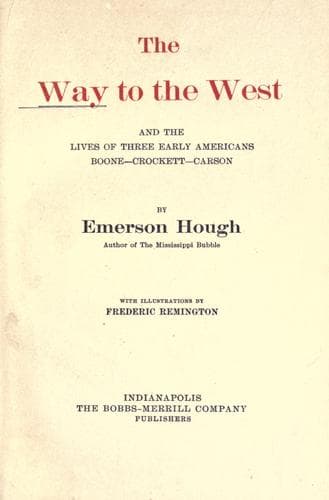
The Way to the West, and the Lives of Three Early Americans: Boone—Crockett—CarsonHough, Emerson
History
The Way to the West, and the Lives of Three Early Americans: Boone—Crockett—Carson
Hough, Emerson
Boone, Daniel, 1734-1820; Carson Kit, 1809-1868; Crockett, Davy, 1786-1836; Mississippi River Valley -- History; West (U.S.) -- History
The Spanish contributed most largely to the American holding of that
vast indefinite West of ours that they once claimed, when they allowed
to straggle northward across the plains, into the hand of Indian or
white man, this same lean and wiry horse, carrying to the deserts of
America the courage of his far-off Moorish blood, his African
adaptability to long journeys on short fare.[2] The man that followed
the Ohio and Missouri to the edge of the plains, the trapper, the
hunter, the adventurer of the fur trade, had been wholly helpless
without the horse. For a time the trading posts might cling to the
streams, but there was a call to a vast empire between the streams,
where one could not walk, where no boat could go, nor any wheeled
vehicle whatever. Here, then, came the horse, the thing needed.
The white adventurer may have brought his horse with him by certain slow
generations of advance, or he may have met him as he moved West; at
times he captured and tamed him for himself, again he bought him of the
Indian, or took him without purchase. Certainly in the great open
reaches of the farther West the horse became man’s most valuable
property, the unit of all recognized current values. The most serious,
the most unforgivable crime was that of horse stealing. To kill a man in
war, man to man, was a matter of man and man, and to be regarded at
times with philosophy; but to take away without quarrel and by stealth
what was most essential to man’s life or welfare was held equivalent to
murder unprovoked and of a despicable nature. To be “set afoot” was one
of the horrors long preserved in memory by the idiom of Western speech.
The food of this horse, then, was generally what he might gain by
forage. In furnishings, his bridle was sometimes a hide lariat, his
saddle the buckskin pad of the Indians. Stirrups the half-wild white man
sometimes discarded, after the fashion of the Indian, who rode by the
clinging of his legs turned back, or by purchase of his toes thrust in
between the foreleg and the body of his mount. A fleet horse, one much
valued in the chase or in war, might be his master’s pet, tied close to
his house of skin at night, or picketed near-by at the lonesome bivouac.
He might have braided in his forelock the eagle feather that his white
master himself would have disdained to wear as ornament. Of grooming the
horse knew nothing, neither did he ever know a day of shelter.
Public-domain text, read in full here on John Shaqi.
Reviews
Reviews
No reviews yet
Be the first to share your thoughts on this work.
Join the Discussion
Join the discussion
Sign in to leave a comment or review.
Sign InorCreate an account