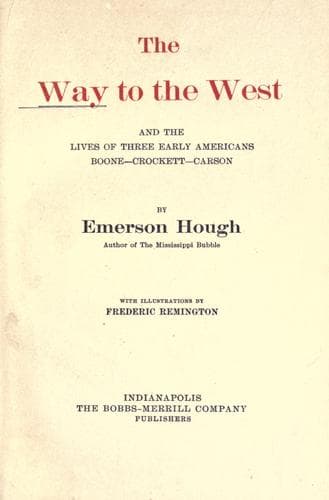
The Way to the West, and the Lives of Three Early Americans: Boone—Crockett—Carson — John Shaqi
The Way to the West, and the Lives of Three Early Americans: Boone—Crockett—CarsonHough, Emerson
History
The Way to the West, and the Lives of Three Early Americans: Boone—Crockett—Carson
Hough, Emerson
Boone, Daniel, 1734-1820; Carson Kit, 1809-1868; Crockett, Davy, 1786-1836; Mississippi River Valley -- History; West (U.S.) -- History
His stable was the heart of a willow thicket if the storm blew fierce.
In winter-time his hay was the bark of the cottonwood, under whose
gnarled arms the hunter had pitched his winter tepee or built his rough
war-house of crooked logs. When all the wide plain was a sheet of white,
covered again by the driven blinding snows of the prairie storm, then
this hardy animal must paw down through the snow and find his own food,
the dried grass curled close to the ground. Where the ox would perish
the horse could survive. He was simple, practicable, durable, even under
the hardest conditions. The horse of the American West ought to have
place on the American coat of arms.
The horse might be a riding animal, or at times a beast of burden. In
the earliest days he was packed simply, sometimes with hide pockets or
panniers after the Indian fashion, with a lash rope perhaps holding the
load together roughly. Later on in the story of the West there came a
day when it was necessary to utilize all energies more exactly, and then
the loading of the horse became an interesting and intricate science.
The carry-all or pannier was no longer essential, and the packs were
made up of all manner of things transported. The pack saddle, a pair of
X’s connected with side bars, the “saw buck” pack-saddle of the West,
which was an idea perhaps taken from the Indians, was the immediate aid
of the packer. The horse and the lash rope in combination were born of
necessity, the necessity of long trails across the mountains and the
plains.
Thus the horse trebled the independence of the Western man, made it
possible for him to travel as far as he liked across unknown lands, made
him soldier, settler, trader, merchant; enabled him indeed to build a
West that had grown into giant stature even before the day of steam.
-----
Footnote 2:
“Wherever pictographs of the horse appear the representations must
have been done subsequent to the advent of Coronado, or the
conquistadors of Florida. There are no horse portraits in Arizona and
vicinity, nor up the Pacific coast, but they are frequent in Texas and
in the trans-Mississippi region. The domestic horse (not Eohippus, the
diminutive quaternary animal which was indigenous) was introduced into
Florida from Santo Domingo by the Spaniards early in the 15th century,
as well as into South America, where it spread in fifteen years as far
south as Patagonia.”—Chas. Hallock, the “American Antiquarian,”
January, 1902.
CHAPTER V
THE PATHWAY OF THE WATERS[3]
Public-domain text, read in full here on John Shaqi.
Reviews
Reviews
No reviews yet
Be the first to share your thoughts on this work.
Join the Discussion
Join the discussion
Sign in to leave a comment or review.
Sign InorCreate an account