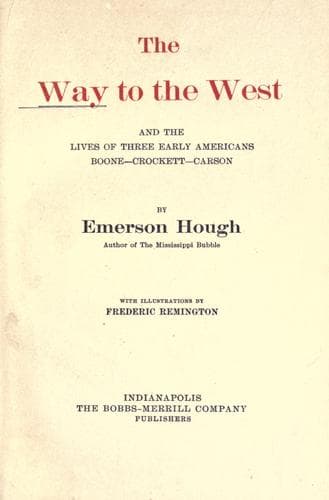
The Way to the West, and the Lives of Three Early Americans: Boone—Crockett—CarsonHough, Emerson
History
The Way to the West, and the Lives of Three Early Americans: Boone—Crockett—Carson
Hough, Emerson
Boone, Daniel, 1734-1820; Carson Kit, 1809-1868; Crockett, Davy, 1786-1836; Mississippi River Valley -- History; West (U.S.) -- History
On a busy street of a certain Western city there appeared, not long ago,
a figure whose peculiarities attracted the curious attention of the
throng through which he passed. It was a man, tall, thin, bronzed,
wide-hatted, long-haired, clad in the garb of a day gone by. How he came
to the city, whence he came, or why, it boots little to ask. There he
was, one of the old-time “long-haired men” of the West. His face,
furrowed with the winds of the high plains and of the mountains, and
bearing still the lines of boldness and confidence, had in these new
surroundings taken on a shade of timorous anxiety. His eye was
disturbed. At his temples the hair was gray, and the long locks that
dropped to his shoulders were thin and pitiful. A man of another day, of
a bygone country, he babbled of scoutings, of warfare with savages, of
the chase of the buffalo. None knew what he spoke. He babbled, grieved,
and vanished.
Into the same city there wandered, from a somewhat more recent West,
another man grown swiftly old. Ten years earlier this figure might have
been seen over all the farming-lands of the West, most numerous near the
boom towns and the land-offices. He was here transplanted, set down in
the greatest boom town of them all, but, alas! too old and too alien to
take root.
He wore the same long-tailed coat, the same white hat that marked him
years ago—tall-crowned, not wide-rimmed; the hat that swept across the
Missouri River in the early eighties. His beard was now grown gray, his
eye watery, his expression subdued, and no longer buoyantly and
irresistibly hopeful. His pencil, as ready as ever to explain the price
of lots or land, had lost its erstwhile convincing logic. From his soul
had departed that strange, irrational, adorable belief, birthright of
the American that was, by which he was once sure that the opportunities
of the land that bore him were perennial and inexhaustible. This man
sought now no greatness and no glory. He wanted only the chance to make
a living. And, think you, he came of a time when a man might be a
carpenter at dawn, merchant at noon, lawyer by night, and yet be
respected every hour of the day, if he deserved it as a man.
It was exceeding sweet to be a savage. It is pleasant to dwell upon the
independent character of Western life, and to go back to the glories of
that land and day when a man who had a rifle and a saddle-blanket was
sure of a living, and need ask neither advice nor permission of any
living soul. Those days, vivid, adventurous, heroic, will have no
counterpart on the earth again. Those early Americans, who raged and
roared across the West, how unspeakably swift was the play in which they
had their part! There, surely, was a drama done under the strictest law
of the unities, under the sun of a single day.
Public-domain text, read in full here on John Shaqi.
Reviews
Reviews
No reviews yet
Be the first to share your thoughts on this work.
Join the Discussion
Join the discussion
Sign in to leave a comment or review.
Sign InorCreate an account