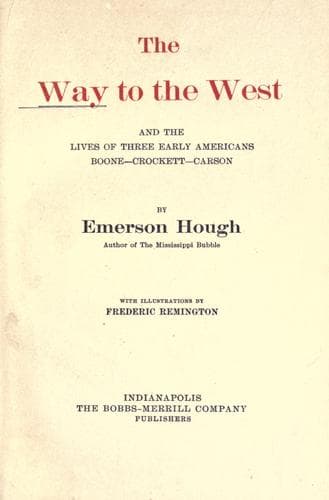
The Way to the West, and the Lives of Three Early Americans: Boone—Crockett—CarsonHough, Emerson
History
The Way to the West, and the Lives of Three Early Americans: Boone—Crockett—Carson
Hough, Emerson
Boone, Daniel, 1734-1820; Carson Kit, 1809-1868; Crockett, Davy, 1786-1836; Mississippi River Valley -- History; West (U.S.) -- History
No fiction can ever surpass in vividness the vast, heroic drama of the
West. The clang of steel, the shoutings of the captains, the stimulus of
wild adventure—of these things, certainly, there has been no lack.
There has been close about us for two hundred years the sweeping action
of a story keyed higher than any fiction, more unbelievably bold, more
incredibly keen in spirit. And now we come upon the tame and tranquil
sequel of that vivid play of human action. “Anticlimax!” cries all that
humanity that cares to think, that dares to regret, that once dared to
hope. “Tell us of the West that was,” demands that humanity, and with
the best of warrant; “play for us again the glorious drama of the past,
and let us see again the America that once was ours.”
Historian, artist, novelist, poet, must all in some measure fail to
answer this demand, for each generation buries its own dead, and each
epoch, to be understood, must be seen in connection with its own living
causes and effects and interwoven surroundings. Yet it is pleasant
sometimes to seek among causes, and I conceive that a certain interest
may attach to a quest that goes farther than a mere summons for the
spurred and booted Western dead to rise. Let us ask, What was the West?
What caused its growth and its changes? What was the Western man, and
why did his character become what it was? What future is there for the
West to-day? We shall find that the answers to these questions run wider
than the West, and, indeed, wider than America.
In the pursuit of this line of thought we need ask only a few broad
premises. These premises may leave us not so much of self-vaunting as we
might wish, and may tend to diminish our esteem of the importance of
individual as well as national accomplishment; for, after all and before
all, we are but flecks on the surface of the broad, moving ribbon of
fate. We are all,—Easterner and Westerner, dweller of the Old World or
the New, bond or free, of to-day or of yesterday,—but the result of the
mandate that bade mankind to increase and multiply, that bade mankind to
take possession of the earth. We have each of us taken over temporarily
that portion of the earth and its fullness allotted or made possible to
us by that Providence to which all things belong. We have each of us
done this along the lines of the least possible resistance, for this is
the law of organic life.
The story of the taking over of the earth into possession has been but a
story of travel. Aryan, Cymri, Goth, Vandal, Westerner—they are all
one. The question of occupying the unoccupied world has been only a
question of transportation, of invasion, and of occupation along the
lines of least resistance. Hence we have at hand, in a study of
transportation of the West at different epochs, a clue that will take us
very near to the heart of things.
Public-domain text, read in full here on John Shaqi.
Reviews
Reviews
No reviews yet
Be the first to share your thoughts on this work.
Join the Discussion
Join the discussion
Sign in to leave a comment or review.
Sign InorCreate an account