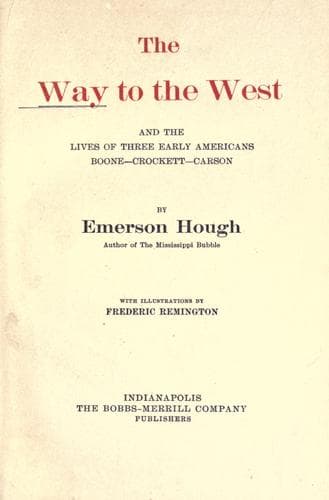
The Way to the West, and the Lives of Three Early Americans: Boone—Crockett—Carson — John Shaqi
The Way to the West, and the Lives of Three Early Americans: Boone—Crockett—CarsonHough, Emerson
History
The Way to the West, and the Lives of Three Early Americans: Boone—Crockett—Carson
Hough, Emerson
Boone, Daniel, 1734-1820; Carson Kit, 1809-1868; Crockett, Davy, 1786-1836; Mississippi River Valley -- History; West (U.S.) -- History
We read to-day of forgotten Phenicia and of ancient Britain. They were
unlike, because they were far apart. The ancient captains who directed
the ships that brought them approximately together were great men in
their day, fateful men. The captains of transportation that made all
America one land are still within our reach, great men, fateful men; and
they hold a romantic interest under their grim tale of material things.
You and I live where they said we must live. It was they who marked out
the very spot where the fire was to rise upon your hearth-stone. You
have married a certain Phenician because they said that this must be
your fate. Your children were born because some captain said they should
be. You are here not of your own volition. The day of volitions, let us
remember, is gone.
The West was sown by a race of giants, and reaped by a race far
different and in a day dissimilar. Though the day of rifle and ax, of
linsey-woolsey and hand-ground meal, went before the time of
trolley-cars and self-binders, of purple and fine linen, it must be
observed that in the one day or the other the same causes were at work,
and back of all these causes were the original law and the original
mandate. The force of this primeval impulse was behind all those early
actors, and Roundhead Cavalier, praying man and fighting man, who had
this continent for a stage. It was behind the men that followed inland
from the sea the first prophets of adventure. It is behind us to-day.
The Iliad of the West is only the story of a mighty pilgrimage.
When the Spaniard held the mouth of the Great River, the Frenchman the
upper sources, the American only the thin line of coast whose West was
the Alleghanies, how then did the west-bound adventurers travel, these
folk who established half a dozen homes for every generation? The answer
would seem easy. They traveled as did the Cimri, the Goths—in the
easiest way they could. It was a day of raft and boat, of saddle-horse
and pack-horse, of ax and rifle, and little other luggage. Mankind
followed the pathways of the waters.
Public-domain text, read in full here on John Shaqi.
Reviews
Reviews
No reviews yet
Be the first to share your thoughts on this work.
Join the Discussion
Join the discussion
Sign in to leave a comment or review.
Sign InorCreate an account