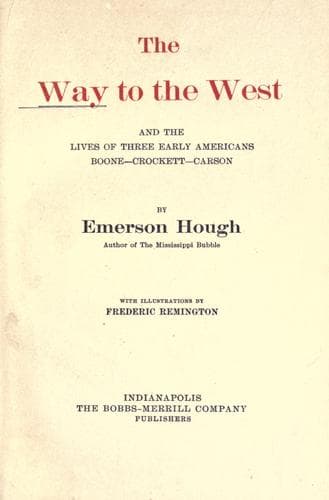
The Way to the West, and the Lives of Three Early Americans: Boone—Crockett—CarsonHough, Emerson
History
The Way to the West, and the Lives of Three Early Americans: Boone—Crockett—Carson
Hough, Emerson
Boone, Daniel, 1734-1820; Carson Kit, 1809-1868; Crockett, Davy, 1786-1836; Mississippi River Valley -- History; West (U.S.) -- History
Bishop Berkeley, prophetic soul, wrote his line: “Westward the course of
empire takes its way.” The public has always edited it to read the
“star” of empire that “takes it way” to the West. If one will read this
poem in connection with a government census map, he can not fail to see
how excellent is the amendment. Excellent census map, that holds between
its covers the greatest poem, the greatest drama ever written! Excellent
census map, that marks the center of population of America with a
literal star, and, at the curtain of each act, the lapse of each ten
years, advances this star with the progress of the drama, westward,
westward, ever westward! Excellent scenario, its scheme done in red and
yellow and brown, patched each ten years, ragged, blurred, until, after
a hundred years, the scheme is finished, and the color is solid all
across the page, showing that the end has come, and that the land has
yielded to the law!
The first step of this star of empire, that concluded in 1800, barely
removed it from its initial point on the Chesapeake. The direction was
toward the southwestern corner of Pennsylvania. The government at
Washington, young as it was, knew that the Ohio River, reached from the
North by a dozen trails from the Great Lakes, and running out into that
West which even then was coveted by three nations, was of itself a
priceless possession. The restless tide of humanity spread from that
point according to principles as old as the world. Having a world before
them from which to choose their homes, the men of that time sought out
those homes along the easiest lines.
The first thrust of the out-bound population was not along the parallels
of latitude westward, as is supposed to be the rule, but to the south
and southeast, into the valleys of the Appalachians, where the hills
would raise corn, and the streams would carry it. The early emigrants
learned that a raft would eat nothing, that a boat runs well
down-stream. Men still clung to the seaboard region, though even then
they exemplified the great law of population that designates the river
valleys to be the earliest and most permanent centers of population. The
first trails of the Appalachians were the waterways.
Dear old New England, the land sought out as the home of religious
freedom, and really perhaps the most intolerant land the earth ever
knew, sometimes flatters herself that she is the mother of the West. Not
so. New England holds mortgages only on the future of the West, not on
its past. The first outshoots of the seaboard civilization to run forth
into the West did not trace back to the stern and rock-bound shore where
the tolerants were punishing those who did not agree with them.
Public-domain text, read in full here on John Shaqi.
Reviews
Reviews
No reviews yet
Be the first to share your thoughts on this work.
Join the Discussion
Join the discussion
Sign in to leave a comment or review.
Sign InorCreate an account