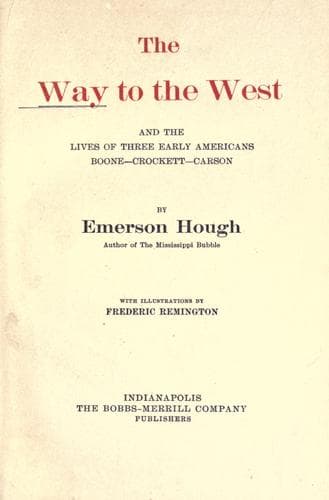
The Way to the West, and the Lives of Three Early Americans: Boone—Crockett—CarsonHough, Emerson
History
The Way to the West, and the Lives of Three Early Americans: Boone—Crockett—Carson
Hough, Emerson
Boone, Daniel, 1734-1820; Carson Kit, 1809-1868; Crockett, Davy, 1786-1836; Mississippi River Valley -- History; West (U.S.) -- History
New York, then, was perhaps the parent of the West? By no means, however
blandly pleasant that belief might be to many for whom New York must be
ever the first cause and center of the American civilization, not the
reflection-point of that civilization. The rabid Westerner may enjoy the
thought that neither New England nor New York was the actual ancestor.
Perhaps he may say that the West had no parent, but was born
Minerva-like. In this he would be wrong. The real mother of the West was
the South. It was she who bore this child, and it has been much at her
expense that it has grown so large and matured so swiftly. If you sing
“arms and the man” for the West, you must sing Southerner and not
Puritan, knight-errant and not psalmodist. The path of empire had its
head on the Chesapeake. There was the American Ararat.
* * * * *
“The great American journeyings were far under way before New England
appeared to realize that there was a greater America toward the West.
The musket bearers of the New England states, the fighting men of the
South, and the riflemen of what might already have been called the West,
had finished the Revolutionary War long before New England had turned
her eyes westward. The pilgrimage over the Appalachians was made, the
new provinces of Kentucky and Tennessee were fighting for a commerce and
a commercial highway of their own, while yet the most that New England,
huddled along her stern and rock-bound shore, could do was to talk of
shutting off these Westerners from their highway of the Mississippi, and
compelling them to trade back with the tidewater provinces of what was
not yet an America.
“Canny and cautious, New York and New England were ready to fear this
new country in which they refused to believe; were ready to cripple it,
although they declined to credit its future. The pioneers of the South
fought their way into the West. New England bought her way, and that
after all the serious problems of pioneering had been solved. The ‘Ohio
Land Company’ of Rufus Putnam, Benjamin Tucker and their none too honest
associate, the New Bedford preacher, Manasseh Cutler, were engaged in
the first great land steal ever known in the West. They did not fight
the Indians for their holdings, but went to Congress, and with practical
methods secured five million acres of land at a price of about eight or
nine cents an acre; the first offer to Congress being a million dollars
for a million and a half acres of what is now the state of Ohio, the
payment to be in soldiers’ scrip, worth twelve cents on the dollar.
“The Ohio company took its settlers out to its new land as a railway
does its colonists to-day. Reaching the Ohio River, they descended it in
a bullet-proof barge, called ‘with strange irony’ the ‘Mayflower.’ They
entered the mouth of the Muskingum and anchored under the guns of a
United States fort.”[4]
Public-domain text, read in full here on John Shaqi.
Reviews
Reviews
No reviews yet
Be the first to share your thoughts on this work.
Join the Discussion
Join the discussion
Sign in to leave a comment or review.
Sign InorCreate an account