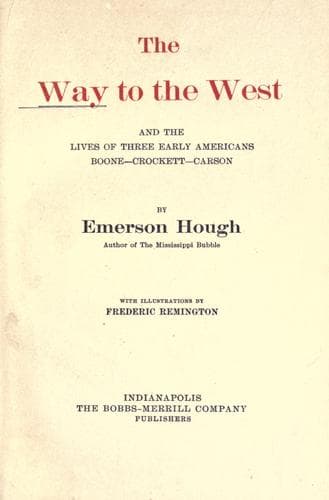
The Way to the West, and the Lives of Three Early Americans: Boone—Crockett—CarsonHough, Emerson
History
The Way to the West, and the Lives of Three Early Americans: Boone—Crockett—Carson
Hough, Emerson
Boone, Daniel, 1734-1820; Carson Kit, 1809-1868; Crockett, Davy, 1786-1836; Mississippi River Valley -- History; West (U.S.) -- History
This is how New England got into the West. There is no hero story there.
The men of the South, men of North Carolina and Virginia, most of whom
had come from Pennsylvania and dropped down along the east slope of the
Appalachians, as it were sparring these mountain ranges for an opening
until at length they had found the ways of the game trails and Indian
trails from headwater to headwater, and so had reached the west-bound
streams—these actual adventurers had built Harrodsburg and
Boonesborough seventeen years before the Ohio company entered the
Muskingum. Already there was a West; even a West far beyond
Boonesborough and its adjacent corn grounds.
This actual record of the upper states in the exploration of the West is
to-day not generally remembered nor understood. Sometimes an ardent New
Englander will explain that the Puritans would have earlier pressed out
westward had it not been for the barrier of the Iroquois on their
western borders. They read their history but ill who do not know that
the Iroquois trafficked always with the English as against the French;
whereas Kentucky, the land opened by the Southern pioneers, was occupied
by a more dangerous red population, made up of many tribes, having no
policy but that of war, and no friends outside of each separate motley
hunting party, sure to be at knife’s point with either white or red
strangers. The most difficult and most dangerous frontier was that of
the South; yet it was the South that won through.
There are two explanations of this incontrovertible historical fact. One
lies perhaps in the general truth that early pioneers nearly always
cling to the river valleys, perhaps not more for purposes of
transportation by water than in obedience to a certain instinct that
seems to hold the pathways of the streams as foreordained guidance. The
man that is lost in the wilderness hails with delight the appearance of
a stream. It will lead him somewhere; it will guide him back again. Near
it will be game, near it, too, rich soil. The man that enters the
wilderness deliberately does so along the waterways.
All the great initial explorations have been made in this way. The men
of Kentucky and Tennessee having reached the headwaters of the Kentucky,
the Tennessee, the Holston or kindred riverways, moved out into their
promised land along paths, as it were, foreordained. The rivers of the
North did not run out into the West, but pointed ever toward the sea.
This is one explanation of the somewhat inglorious part of New England
in the discovery of the West. It does not explain her narrowness of view
in regard to that West after it had been discovered by others; neither
does this geographical explanation, in the opinion of many, cover the
main phenomena of her timid attitude in regard to Western exploration.
Public-domain text, read in full here on John Shaqi.
Reviews
Reviews
No reviews yet
Be the first to share your thoughts on this work.
Join the Discussion
Join the discussion
Sign in to leave a comment or review.
Sign InorCreate an account