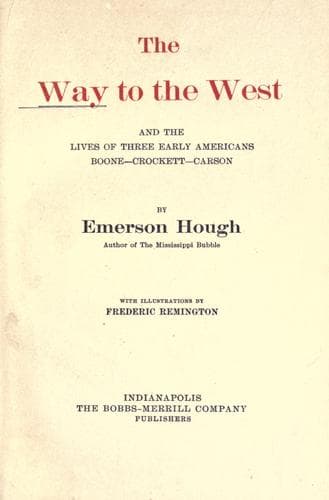
The Way to the West, and the Lives of Three Early Americans: Boone—Crockett—CarsonHough, Emerson
History
The Way to the West, and the Lives of Three Early Americans: Boone—Crockett—Carson
Hough, Emerson
Boone, Daniel, 1734-1820; Carson Kit, 1809-1868; Crockett, Davy, 1786-1836; Mississippi River Valley -- History; West (U.S.) -- History
The true reason, in the belief of these students, is to be found in the
character of the New England population, as compared to the bolder breed
of men who overran the western sections of Pennsylvania and for two
generations were in continuous touch with the wilderness and its
savagery. This subject is taken up interestingly by Horace Kephart, a
scholar of much acquaintance with early American history, in the course
of an able paper. It is very much worth while for any one who wishes an
actual picture of the march across the Appalachians to read his
conclusions.
“In a vague way we think of all the East as old,” says this writer, “and
all the West as new. We picture civilization as advancing westward from
the Atlantic in a long, straight front, like a wave or a line of battle.
But in point of fact it was not so. There was a permanent settlement of
Europeans a thousand miles to the west of us before the Pilgrims landed
at Plymouth. Cahokia and Kaskaskia were thriving villages before
Baltimore was founded; and our own city of St. Louis was building in the
same year that New Jersey became a British possession. At a time when
Daniel Boone was hunting beaver on the Osage and the Missouri, Fenimore
Cooper was drawing the types for future ‘Leatherstocking Tales’ from his
neighbors in a ‘wilderness’ only a hundred and fifty miles from New York
City.
“American settlement advanced toward the Mississippi in the shape of a
wedge, of which the entering edge was first Lancaster, in Pennsylvania,
then the Shenandoah valley, then Louisville, and finally St. Louis. When
the second census of the United States was taken, in 1800, nearly all
the white inhabitants of our country lived in a triangle formed by a
diagonal southwestward from Portland, Maine, to the mouth of the
Tennessee River, here meeting another diagonal running northwestward
from Savannah, with the Atlantic for a base. Central and western New
York, northern Pennsylvania, and all the territory north of the Ohio
River, save in its immediate vicinity, were almost uninhabited by
whites, and so were Georgia, Alabama, and Mississippi. Yet the state of
Kentucky had half as many people as Massachusetts, and Tennessee had
already been admitted into the Union.
“As a rule, geographical expansion proceeds along the lines of least
resistance, following the natural highways afforded by navigable rivers
and open plains. It is easily turned aside by mountain chains, dense
forests, and hostile natives. Especially was this true in the days
before railroads. But the development of our older West shows a striking
exception to this rule; for the entering wedge was actually driven
through one of the most rugged, difficult, and inhospitable regions to
be found along the whole frontier of the British possessions.
Public-domain text, read in full here on John Shaqi.
Reviews
Reviews
No reviews yet
Be the first to share your thoughts on this work.
Join the Discussion
Join the discussion
Sign in to leave a comment or review.
Sign InorCreate an account