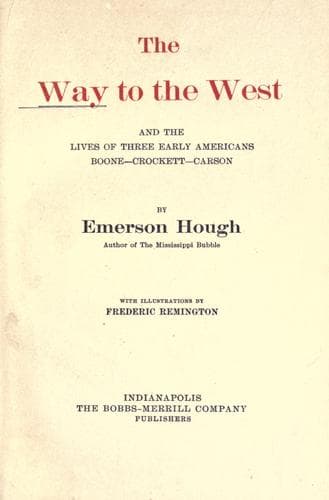
The Way to the West, and the Lives of Three Early Americans: Boone—Crockett—CarsonHough, Emerson
History
The Way to the West, and the Lives of Three Early Americans: Boone—Crockett—Carson
Hough, Emerson
Boone, Daniel, 1734-1820; Carson Kit, 1809-1868; Crockett, Davy, 1786-1836; Mississippi River Valley -- History; West (U.S.) -- History
“This fact is strange enough to fix our attention; but it is doubly
strange when we consider that there was no climatic, political nor
economic necessity for such defiance of nature’s laws. We can see why
the Mississippi should have been explored from the north, rather than
from its mouth, because Canada was settled before Louisiana, and it is
easier to float downstream than to pole or cordelle against the current.
But why was not the West entered and settled through the obviously easy
course of the Mohawk Valley?
“Beyond this valley were gentle slopes, and many a route practicable for
settlers into the rich country of Ohio. The central trail of the
Iroquois, beaten smoother than a wagon-road, ran straight west from
Albany, through the fairest portion of New York, to the present site of
Buffalo, and thence followed the southern shore of Lake Erie into Ohio.
Where it crossed the Genesee, the old war-trail of the Senecas branched
off to the south, passing behind the farthermost ramparts of the
Alleghanies, to the forks of the Ohio. Moccasined feet traveling over
these trails for centuries had worn them from three to twelve inches
into the ground, so that they were easy to follow on the darkest night.
These were only two of several well-marked routes from ancient Albany to
the new West. It was to this easy communication with the country beyond
the Appalachians that the Iroquois owed their commanding position on the
continent.
“These Iroquois were in the way, to be sure; but with them New York had
every advantage over her sister provinces. Her policy toward these
powerful Indians was conciliatory. She was allied with them against the
French. The Six Nations ravaged the frontiers of all the other colonies,
from Massachusetts to Carolina, and carried their conquests to the
Mississippi, but they spared New York and even invited her to build
forts on their border as outposts against the French. New York had the
most influential Indian agent of his time in Sir William Johnson, who
had married the sister of the Mohawk chief Brant, and by her had several
sons who were war-chiefs of the Iroquois. In 1745 the Iroquois even
ceded to New York a strip of land sixty miles wide, along the southern
shores of lakes Ontario and Erie, extending to the modern Cleveland. It
should have been easy for the Knickerbockers to secure passage for their
emigrants into the western country had they chosen to ask it.
Public-domain text, read in full here on John Shaqi.
Reviews
Reviews
No reviews yet
Be the first to share your thoughts on this work.
Join the Discussion
Join the discussion
Sign in to leave a comment or review.
Sign InorCreate an account