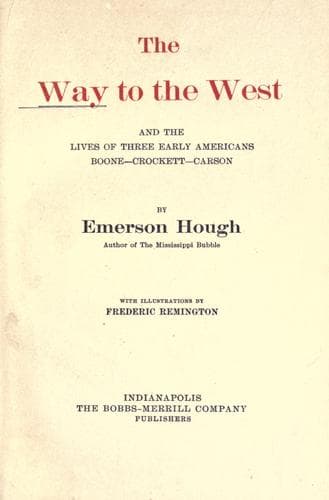
The Way to the West, and the Lives of Three Early Americans: Boone—Crockett—CarsonHough, Emerson
History
The Way to the West, and the Lives of Three Early Americans: Boone—Crockett—Carson
Hough, Emerson
Boone, Daniel, 1734-1820; Carson Kit, 1809-1868; Crockett, Davy, 1786-1836; Mississippi River Valley -- History; West (U.S.) -- History
“On the other hand, the southern colonies had no easy access to the
West. Nature herself had bidden these people to rest content in their
tidewater regions, and frowned upon any westward expansion by
interposing the mighty barriers of the Blue Ridge and the Alleghanies,
rising tier beyond tier in parallel chains from northern Pennsylvania to
Alabama. Few trails crossed these mountains. From base to summit they
were clad in dense forest, matted into jungle by luxuriant undergrowth.
No one knew what lay beyond them, nor how far through this ‘forest,
savage, harsh, impregnable,’ the traveler must bore until he reached
land fit for settlement.
“It was well known, however, that the trans-Alleghany region, whatever
might be its economic features, was dangerous ground. The Indians
themselves could not occupy it, for it had been for ages the common
battle-ground of opposing tribes. Any savage met within its confines was
sure to be on the war-path against any and all comers. He that entered
took his life in his hand.
“Thus the chances of success in any westward movement were in favor of
New York and New England, and against Pennsylvania. Yet it was the
latter that did the work. Central and western New York remained a
wilderness until Missouri was settling with Americans. New England took
little or no part in Western affairs until, the West having been won,
Massachusetts and Connecticut, calmly overstepping New York and
Pennsylvania, laid thrifty hand upon the public domain north of
Pittsburg and west to the Mississippi.
“We have seen that the West was actually entered by the most difficult
and hostile route, and this in spite of political and economic reasons
for choosing a more northerly and easier line of advance. I do not
remember that this has ever before been pointed out; but it is a fact of
deep significance, for it determined what should be the temper of the
great West, and what should be its course of development.
“The wedge of settlement was driven through the heart of the Alleghanies
because there dwelt at the foot of the mountains a people more
aggressive, more daring, and more independent than the tidewater stock.
This people acted on its own initiative, not only without government
aid, but sometimes in defiance of government. It won to the American
flag not only the central West, but the Northwest and Southwest as well;
and it was, for the most part, the lineal descendants of these men that
first, of Americans, explored the far West, and subdued it for future
settlement.
Public-domain text, read in full here on John Shaqi.
Reviews
Reviews
No reviews yet
Be the first to share your thoughts on this work.
Join the Discussion
Join the discussion
Sign in to leave a comment or review.
Sign InorCreate an account