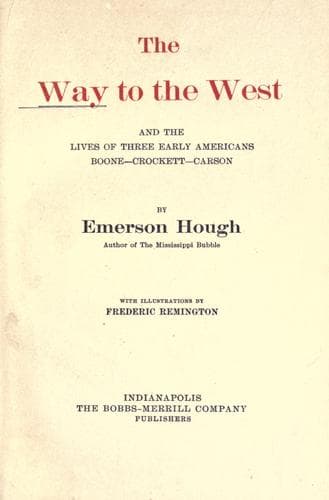
The Way to the West, and the Lives of Three Early Americans: Boone—Crockett—CarsonHough, Emerson
History
The Way to the West, and the Lives of Three Early Americans: Boone—Crockett—Carson
Hough, Emerson
Boone, Daniel, 1734-1820; Carson Kit, 1809-1868; Crockett, Davy, 1786-1836; Mississippi River Valley -- History; West (U.S.) -- History
“This explains why Missouri, rather than the northern tier of new
states, became in its turn the vanguard and outpost of civilization, as
Kentucky and Tennessee had been before her, and Virginia and
Pennsylvania before them. It explains why, when mountain and forest
barriers had been left behind, and the vast Western plain offered
countless parallel routes of travel to the Rockies, such routes were not
used, but all the great transcontinental trails, whether to Santa Fé,
California, or Oregon, focused for half a century at St. Louis or
Independence. It explains why the majority of our famous scouts and
explorers and Indian fighters were men whose strain went back to the
Shenandoah valley or the Yadkin, and why most of them could trace their
descent still farther back to Pennsylvania, mother of Western pioneers.”
There is much that is convincing in this study of facts and motives; yet
perhaps the gentler and broader view is not that of personnel but of
geography. I myself am more disposed to believe that St. Louis became
great by reason of her situation on the great interior pathways of the
waters; though all this may be said with no jot of abatement in
admiration for the magnificent daring and determination of those men of
the lower slopes of the Appalachians who, as history shows simply and
unmistakably, were really the pioneers of the eastern, the middle and
the most western portions of the splendid empire of the West. Let us
reserve for a later chapter the more specific study of this typical
adventurer and his origin, and pass for the present to the general
consideration of the figure that we may call the American west-bound
man.
* * * * *
We must remember that there had been two or three full American
generations to produce him, this man that first dared turn away from the
seaboard and set his face toward the sinking of the sun, toward the dark
and mysterious mountains and forests, which then encompassed the least
remote land fairly to be called the West. Two generations had produced a
man different from the Old-World type. Free air and good food had given
him abundant brawn. He was tall, with Anak in his frame. Little fat
cloyed the free play of his muscles, and there belonged to him the
heritage of the courage that comes of good heart and lungs. He was a
splendid man to have for an ancestor, this tall and florid athlete that
never heard of athletics. His face was thin and aquiline, his look high
and confident, his eye blue, his speech reserved. You may see this same
man yet in those restricted parts of this country which remain fit to be
called American. You may see him sometimes in the mountains of
Tennessee, the brakes of Arkansas or Missouri, where the old strain has
remained most pure. You might have seen him over all the West in the
generation preceding our own.
Public-domain text, read in full here on John Shaqi.
Reviews
Reviews
No reviews yet
Be the first to share your thoughts on this work.
Join the Discussion
Join the discussion
Sign in to leave a comment or review.
Sign InorCreate an account