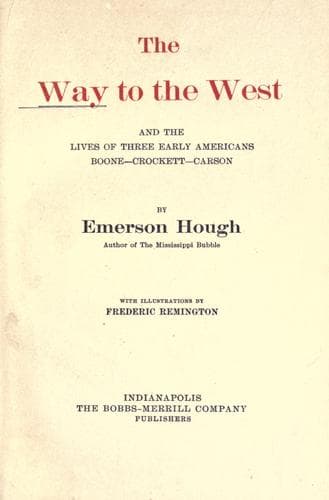
The Way to the West, and the Lives of Three Early Americans: Boone—Crockett—CarsonHough, Emerson
History
The Way to the West, and the Lives of Three Early Americans: Boone—Crockett—Carson
Hough, Emerson
Boone, Daniel, 1734-1820; Carson Kit, 1809-1868; Crockett, Davy, 1786-1836; Mississippi River Valley -- History; West (U.S.) -- History
Witness this sweet ancient weapon of our fathers, the American rifle,
maker of states, empire builder. Useful as its cousin, the ax, it is in
design simple as the ax; in outline severe, practicable, purposeful in
every regard. It is devoid of ornamentation. The brass that binds the
foot of the stock is there to protect the wood. The metal guard below
the lock is to preserve from injury the light set-triggers. The serrated
edges of the lock plate may show rude file marks of a certain pattern,
but they are done more in careless strength than in cunning or in
delicacy. This is no belonging of a weak or savage man. It is the weapon
of the Anglo-Saxon; that is to say, the Anglo-Saxon in America, who
invented it because he had need for it.
This arm was born of the conditions that surrounded our forefathers in
the densely covered slopes of the Appalachian Divide, in whose virgin
forests there was for the most part small opportunity for extended
vision, hence little necessity for a weapon of long range. The game or
the enemy with which the early frontiersman was concerned was apt to be
met at distances of not more than a hundred or two hundred yards, and
the early rifle was perfect for such ranges.
Moreover, it was only with great difficulty that the frontiersman
transported any weighty articles on his Western pilgrimage. Lead was
heavy, powder was precious, the paths back to the land of such
commodities long and arduous. A marvel of adaptation, the American rifle
swiftly grew to a practical perfection. Never in the history of the arms
of nations has there been produced a weapon whose results have been more
tremendous in comparison to the visible expenditure of energy; never has
there been a more economical engine, or an environment where economy was
more imperative.
The ball of the American rifle was small, forty, sixty or perhaps one
hundred of them weighing scarcely more than a pound. The little, curving
horn, filled with the precious powder grains, carried enough to furnish
many shots. The stock of the rifle itself gave housing to the little
squares of linen or fine leather with which the bullet was patched in
loading. With this tiny store of powder and lead, easily portable food
for this providentially contrived weapon, the American frontiersman
passed on silently through the forest, a master, an arbiter, ruler of
savage beast or savage foeman, and in time master of the civilized
antagonist that said him nay.
We shall observe that the state of Pennsylvania was the starting point
of the westward movement of our frontiersmen. We shall find also that
the first American small-bore, muzzle-loading rifles were made in
Pennsylvania. The principle of the rifle, the twist in the bore, is
thought to have originated in the German states of the Palatinate, but
it was left for America to improve it and to perfect its use.
Public-domain text, read in full here on John Shaqi.
Reviews
Reviews
No reviews yet
Be the first to share your thoughts on this work.
Join the Discussion
Join the discussion
Sign in to leave a comment or review.
Sign InorCreate an account