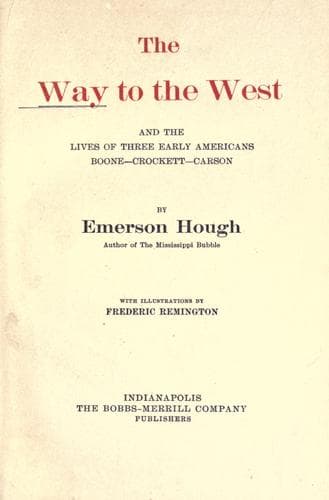
The Way to the West, and the Lives of Three Early Americans: Boone—Crockett—CarsonHough, Emerson
History
The Way to the West, and the Lives of Three Early Americans: Boone—Crockett—Carson
Hough, Emerson
Boone, Daniel, 1734-1820; Carson Kit, 1809-1868; Crockett, Davy, 1786-1836; Mississippi River Valley -- History; West (U.S.) -- History
At Lancaster, Pennsylvania, there was a riflemaker, probably a German by
birth, by name Decherd or Dechert, who began to outline the type of the
American squirrel-rifle or hunting-arm. This man had an apprentice, one
Mills, with ideas of his own. We see this apprentice and his improved
rifle presently in North Carolina; and soon thereafter riflemakers
spring up all over the east slope of the Alleghanies, so that as though
by magic all our hunters and frontiersmen are equipped with this long
rifle, shooting the tiny ball, and shooting it with an accuracy hitherto
deemed impossible in the achievements of firearms.
Withal we may call this a Southern arm, since New England was later in
taking up its use, clinging to the Queen Anne musket when the men of
North Carolina and Virginia scorned to shoot a squirrel anywhere except
in the head. The first riflemen of the Revolutionary War were
Pennsylvanians, Virginians and Marylanders, all Southerners; and deadly
enough was their skill with what the English officers called their
“cursed widow and orphan makers.”
The barrel of the typical rifle of those days was about four feet in
length, the stock slender, short and strongly curved, so that the sights
came easily and directly up to the level of the eye in aiming. The
sights were low and close to the barrel, some pieces being provided with
two hind sights, a foot or so apart, so that the marksman might not draw
either too fine or too coarse a bead with the low silver or bone
crescent of the fore sight. Usually the rear sight was a simple, flat
bar, finely notched, and placed a foot or fifteen inches in front of the
breech of the barrel, so that the eye should focus easily and sharply at
the notch of the rear sight. Such was the care with which the sights
were adjusted that the rifleman sometimes put the finishing touches on
the notch with so soft a cutting tool as a common pin, working away
patiently, a little at a time, lest he should by too great haste go too
deep into the rear sight, and so cause the piece to shoot otherwise than
“true.”
The delicately arranged set-triggers made possible an instantaneous
discharge without any appreciable disturbance of the aim when once
obtained; and the long distance between the hind sight and fore sight,
the steadiness of the piece, owing to its length and weight, the
closeness of the line of sight to the line of the trajectory of a ball
driven with a relatively heavy powder charge, all conspired to render
extreme accuracy possible with this arm, and this accuracy became so
general throughout the American frontier that to be a poor rifle shot
was to be an object of contempt.
Public-domain text, read in full here on John Shaqi.
Reviews
Reviews
No reviews yet
Be the first to share your thoughts on this work.
Join the Discussion
Join the discussion
Sign in to leave a comment or review.
Sign InorCreate an account