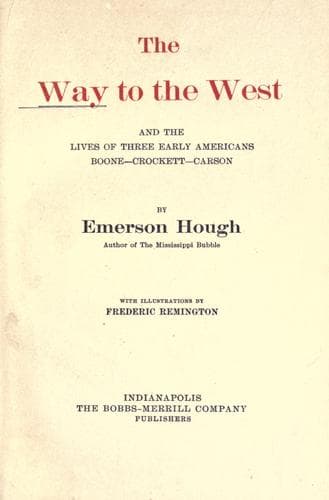
The Way to the West, and the Lives of Three Early Americans: Boone—Crockett—CarsonHough, Emerson
History
The Way to the West, and the Lives of Three Early Americans: Boone—Crockett—Carson
Hough, Emerson
Boone, Daniel, 1734-1820; Carson Kit, 1809-1868; Crockett, Davy, 1786-1836; Mississippi River Valley -- History; West (U.S.) -- History
Each rifle was provided with its own bullet mold, which cast a round
ball of such size that when properly “patched” it fitted the bore of the
piece tightly, so tightly that in some cases a “starter” or section of
false barrel was used, into which the ball was forced, sometimes being
swaged in with a mallet and a short starting rod. The ramrod proper was
carried in pipes attached to the long wooden stock, which extended to
the muzzle of the barrel underneath the piece. One end of this rod was
protected with a brass ferrule, and the other was provided with a screw,
into which was twisted the “worm” used in cleaning the arm.
The pouch of the hunter always carried some flax or tow for use in
cleaning the piece. The rifleman would wind a wisp of this tow about the
end of the “worm,” moisten it by passing it between his lips, and then
pass the tightly fitting wad of tow up and down the barrel until the
latter was perfectly free from powder residue. Then the little ball,
nicely patched, was forced down on the powder charge by the slender
ramrod, made with great care from the toughest straight-grained hickory
wood.
Powder and ball were precious in those early days, and though strong men
ever love the sports of weapons, waste could not be tolerated even in
sport. Sometimes at night the frontiersmen would gather for the pastime
of “snuffing the candle,” and he was considered a clumsy rifleman who
but fanned the flame with his bullet, or cut too deeply into the base of
the candle-wick, and so extinguished the light. Again the riflemen would
engage in “driving the nail” with the rifle ball, or would shoot at a
tiny spot of black on a board or a blazed tree-trunk, firing a number of
balls into the same mark. In nearly all such cases the balls were dug
out of the tree or plank into which they had been fired, and were run
over again into fresh bullets for use at another time. Thus grew the
skill of the American rifleman, with whose weapon most of the feats of
latter day short-range marksmanship could be duplicated.[1]
The early American depended upon his rifle in supporting and defending
his family. Without it he had not dared to move across the Alleghanies.
With it he dared to go anywhere, knowing that it would furnish him food
and fending. When the deer and turkey became less numerous near him, he
moved his home farther westward, where game was more abundant.
Public-domain text, read in full here on John Shaqi.
Reviews
Reviews
No reviews yet
Be the first to share your thoughts on this work.
Join the Discussion
Join the discussion
Sign in to leave a comment or review.
Sign InorCreate an account