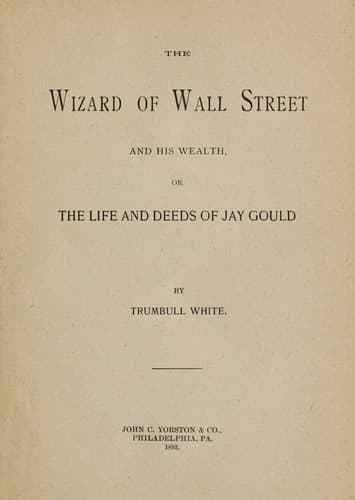
The Wizard of Wall Street and His Wealth; or, The Life and Deeds of Jay Gould — John Shaqi
The Wizard of Wall Street and His Wealth; or, The Life and Deeds of Jay GouldWhite, Trumbull
History
The Wizard of Wall Street and His Wealth; or, The Life and Deeds of Jay Gould
White, Trumbull
Businessmen -- United States -- Biography; Capitalists and financiers -- United States -- Biography; Gould, Jay, 1836-1892
Mr. Henry Adams, in his celebrated chapter, “The New York Gold
Conspiracy,” makes the following interesting explanation of
circumstances preliminary to “Black Friday:” “In order to explain
the operation of a so-called corner in gold to ordinary readers with
the least possible use of slang or technical phrases, two preliminary
statements are necessary. In the first place, it must be understood
that the supply of gold immediately available for transfers is limited
within distinct bonds in America. New York and the country behind it
contain an amount usually estimated at about $20,000,000. The national
government commonly holds from $75,000,000 to $100,000,000, which may
be thrown bodily on the market if the President orders it. To obtain
gold from Europe, or other sources, requires time.
“In the second place, gold in America is a commodity bought and sold
like stocks. In gold, as in stocks, the transactions are both real
and speculative. The real transactions are mostly purchases or loans
made by importers who require coin to pay custom on their imports.
The speculative transactions are mere wagers on the rise or fall of
price, and neither require any actual transfer of gold, or even imply
its existence, although in times of excitement hundreds of millions
nominally are bought, sold and loaned.
“Under the late administration, Mr. McCulloch, then Secretary of the
Treasury, had thought it his duty at least to guarantee a stable
currency, although Congress forbade him to restore the gold standard.
During four years gold had fluctuated little and principally from
natural causes, and the danger of attempting to create an artificial
scarcity in it had prevented the operators from trying an experiment
which would have been sure to irritate the government. The financial
policy of the new administration was not so definitely fixed, and the
success of the speculation would depend on the action of Mr. Boutwell,
the new secretary, whose direction was understood to have begun by a
marked censure on the course pursued by his predecessor.
Public-domain text, read in full here on John Shaqi.
Reviews
Reviews
No reviews yet
Be the first to share your thoughts on this work.
Join the Discussion
Join the discussion
Sign in to leave a comment or review.
Sign InorCreate an account