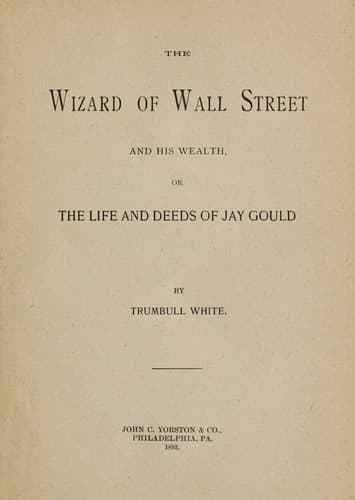
The Wizard of Wall Street and His Wealth; or, The Life and Deeds of Jay GouldWhite, Trumbull
History
The Wizard of Wall Street and His Wealth; or, The Life and Deeds of Jay Gould
White, Trumbull
Businessmen -- United States -- Biography; Capitalists and financiers -- United States -- Biography; Gould, Jay, 1836-1892
“Of all financial operations, cornering gold is the most brilliant and
the most dangerous, and possibly the very hazard and splendor of the
attempt were the reasons of its fascination to Mr. Jay Gould’s fancy.
He dwelt upon it for months and played with it like a pet toy. His
fertile mind even went so far as to discover that it would prove a
blessing to the community, and on this ingenious theory, half honest
and half fraudulent, he stretched the widely extended fabric of the
web in which all mankind was to be caught. This theory was in itself
partially sound. Starting from the principle that the price of grain
in New York is regulated by the price in London, and is not effected
by currency fluctuations, Mr. Gould argued that if it were possible
to raise the premium on gold from 30 to 40 cents at harvest time,
the farmer’s grain would be worth $1.40 instead of $1.30, and as a
consequence the farmer would hasten to send all his crop to New-York
for export over the Erie railway, which was sorely in need of freight.
With the assistance of another gentleman, Mr. Gould calculated the
exact premium at which the western farmer would consent to dispose
of his grain, and thus distance the three hundred sail which were
hastening from the Danube to supply the English market. Gold, which was
then heavy at 34, must be raised to 45.
“This clever idea, like all the other ideas of these gentlemen of Erie,
seems to have had the single fault of requiring that some one somewhere
should be swindled. The scheme was probably feasible; but sooner or
later the reaction from such an artificial stimulant must have come,
and whenever it came, some one must suffer. Nevertheless, Mr. Gould
probably argued that so long as the farmer got his money, the Erie
railway its freights, and he himself his small profits on the gold he
bought, it was of little consequence who else might be injured; and
indeed by the time the reaction came, and gold was ready to fall as
he expected, Mr. Gould would probably have been ready to assist the
process by speculative sales in order to enable the Western farmer to
buy his spring goods cheap, as he had sold his autumn crops dear. He
himself was equally ready to buy gold cheap and sell it dear on his
private account, and as he proposed to bleed New York merchants for the
benefit of the Western farmer, so he was willing to bleed Broad street
for his own. The patriotic object was, however, the one which, for
obvious reasons, Mr. Gould preferred to put forward most prominently
and on the strength of which he hoped to rest his ambitious structure
of intrigue.”
Public-domain text, read in full here on John Shaqi.
Reviews
Reviews
No reviews yet
Be the first to share your thoughts on this work.
Join the Discussion
Join the discussion
Sign in to leave a comment or review.
Sign InorCreate an account