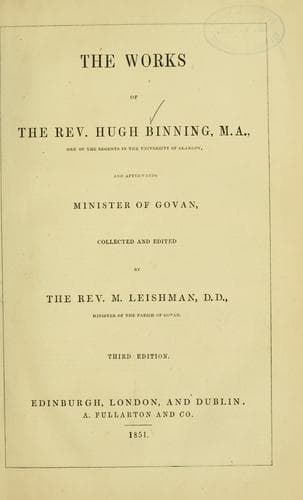
Presbyterian Church -- Sermons; Sermons, English; Theology -- Early works to 1800; Theology -- History -- 17th century
before my Lord Mayor. He answered he was “Sir,” said he, “I came with
earnest desires after the word of God, and hopes of getting some good to
my soul, but I was greatly disappointed, for I could not understand a
great deal of what you said,—you were quite above me.” The Doctor replied,
with tears in his eyes, “Friend, if I did not give you a sermon, you have
given me one.”(65) Massillon was one of the first French preachers who
abstained, in the pulpit, from the use of citations from profane authors.
In the first sermon of his “Petit Careme,” he has a quotation from
Sallust. But he does not name the author, nor does he give the words in
the original. He merely gives the meaning of them, introducing his
quotation in this manner, _as one of the ancients says_, “comme dit un
ancien.” This, it is believed, is the only instance of the kind that is to
be found in the sermons of that eloquent preacher.(66)
Some may be desirous to know how it was that a practice so different from
ours, and so much opposed to the good sense and the good taste of modern
times, was formerly so common, or by what arguments it was attempted to be
defended. Abraham Wright, one of the Fellows of St John the Baptist’s
College, Oxford, undertook this task. He published a book in 1656, under
this title, “Five Sermons in Five several Styles, or Waies of Preaching.”
These different ways of preaching were what he characterized as Bishop
Andrews’ way, Bishop Hall’s way, Dr. Maine and Mr. Cartwright’s way, the
Presbyterian way, and the Independent way. All of the sermons, with the
exception of the last, contain specimens of the “Babylonish dialect” of
the age. But this, in the estimation of Abraham Wright, was not their
least recommendation. “You are also taught from these leaves,” says
he,(67) “that secular learning is not so heathenish, but it may be made
Christian. Plato, and Socrates, and Seneca, were not of such a reprobate
sense, as to stand wholly excommunicate. The same man may be both a poet
and a prophet, a philosopher and an apostle. Virgil’s fancie was as high
as the Magi’s star, and might lead wise men in the West as clearly to
their Saviour, as that light did those Eastern sages. And so, likewise,
Seneca’s positions may become Saint Paul’s text; Aristotle’s metaphysicks
convince an atheist of a God, and his demonstrations prove Shiloes advent
to a Jew. That great apostle of the Gentiles had never converted those
nations, without the help of their own learning. It was the Gentiles
oratorie, yet not without the Holy Ghost’s rhetorick, that did almost
perswade Agrippa to be a Christian; and it was the Gentiles poetrie, but
not without a Deitie in the verse, that taught the Athenians to know an
unknown God. By which you see it is possible that Gamaliel’s feet may be a
step to an apostleship.” This failed to convince the pious editor of the
Works of the ever-memorable John Hales of Eaton, if ever he chanced to see
it.
Public-domain text, read in full here on John Shaqi.
Reviews
Reviews
No reviews yet
Be the first to share your thoughts on this work.
Join the Discussion
Join the discussion
Sign in to leave a comment or review.
Sign InorCreate an account