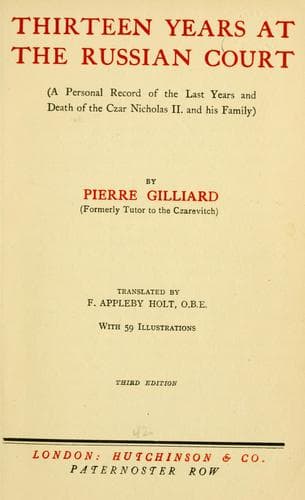
Thirteen years at the Russian court: (a personal record of the last years and death of the Czar Nicholas II. and his family) — John Shaqi
Thirteen years at the Russian court: (a personal record of the last years and death of the Czar Nicholas II. and his family)Gilliard, Pierre
History
Thirteen years at the Russian court: (a personal record of the last years and death of the Czar Nicholas II. and his family)
Gilliard, Pierre
Nicholas II, Emperor of Russia, 1868-1918; Romanov, House of; Soviet Union -- History -- Revolution, 1917-1921 -- Personal narratives
Between each of the attacks, however, the boy came back to life,
recovered his health, forgot his sufferings, and resumed his fun and his
games. At these times it was impossible to credit that he was the victim
of an implacable disease which might carry him off at any moment. Every
time the Czarina saw him with red cheeks, or heard his merry laugh, or
watched his frolics, her heart would fill with an immense hope, and she
would say: “God has heard me. He has pitied my sorrow at last.” Then the
disease would suddenly swoop down on the boy, stretch him once more on
his bed of pain and take him to the gates of death.
The months passed, the expected miracle did not happen, and the cruel,
ruthless attacks followed hard on each other’s heels. The most fervent
prayers had not brought the divine revelation so passionately implored.
The last hope had failed. A sense of endless despair filled the
Czarina’s soul: it seemed as if the whole world were deserting her.[10]
It was then that Rasputin, a simple Siberian peasant, was brought to
her, and he said: “Believe in the power of my prayers; believe in my
help and your son will live!”
The mother clung to the hope he gave her as a drowning man seizes an
outstretched hand. She believed in him with all the strength that was
in her. As a matter of fact, she had been convinced for a long time that
the saviour of Russia and the dynasty would come from the people, and
she thought that this humble _moujik_ had been sent by God to save him
who was the hope of the nation. The intensity of her faith did the rest,
and by a simple process of auto-suggestion, which was helped by certain
perfectly casual coincidences, she persuaded herself that her son’s life
was in this man’s hands.
Rasputin had realised the state of mind of the despairing mother who was
broken down by the strain of her struggle and seemed to have touched the
limit of human suffering. He knew how to extract the fullest advantage
from it, and with a diabolical cunning he succeeded in associating his
own life, so to speak, with that of the child.
This moral hold of Rasputin on the Czarina cannot possibly be understood
unless one is familiar with the part played in the religious life of the
Orthodox world by those men who are neither priests nor monks--though
people habitually, and quite inaccurately, speak of the “monk”
Rasputin--and are called _stranniki_ or _startsi_.
The _strannik_ is a pilgrim who wanders from monastery to monastery and
church to church, seeking the truth and living on the charity of the
faithful. He may thus travel right across the Russian Empire, led by his
fancy or attracted by the reputation for holiness enjoyed by particular
places or persons.
Public-domain text, read in full here on John Shaqi.
Reviews
Reviews
No reviews yet
Be the first to share your thoughts on this work.
Join the Discussion
Join the discussion
Sign in to leave a comment or review.
Sign InorCreate an account