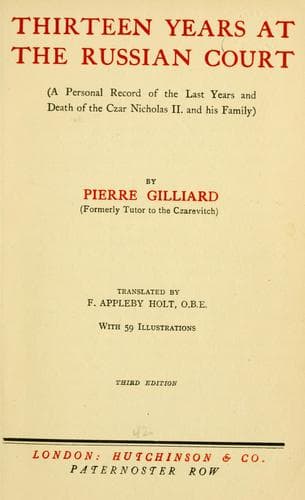
Thirteen years at the Russian court: (a personal record of the last years and death of the Czar Nicholas II. and his family)Gilliard, Pierre
History
Thirteen years at the Russian court: (a personal record of the last years and death of the Czar Nicholas II. and his family)
Gilliard, Pierre
Nicholas II, Emperor of Russia, 1868-1918; Romanov, House of; Soviet Union -- History -- Revolution, 1917-1921 -- Personal narratives
The _staretz_ is an ascetic who usually lives in a monastery, though
sometimes in solitude--a kind of guide of souls to whom one has recourse
in moments of trouble or suffering. Quite frequently a _staretz_ is an
ex-_strannik_ who has given up his old wandering life and taken up an
abode in which to end his days in prayer and meditation.
Dostoïevsky gives the following description of him in _The Brothers
Karamazof_:
“The _staretz_ is he who takes your soul and will and makes them
his. When you select your _staretz_ you surrender your will, you
give it him in utter submission, in full renunciation. He who takes
this burden upon him, who accepts this terrible school of life,
does so of his own free will in the hope that after a long trial he
will be able to conquer himself and become his own master
sufficiently to attain complete freedom by a life of
obedience--that is to say, get rid of self and avoid the fate of
those who have lived their lives without succeeding in sufficing
unto themselves.”
God gives the _staretz_ the indications which are requisite for one’s
welfare and communicates the means by which one must be brought back to
safety.
On earth the _staretz_ is the guardian of truth and the ideal. He is
also the repository of the sacred tradition which must be transmitted
from _staretz_ to _staretz_ until the reign of justice and light shall
come.
Several of these _startsi_ have risen to remarkable heights of modern
grandeur and become saints of the Orthodox Church.
The influence of these men, who live as a kind of unofficial clergy, is
still very considerable in Russia. In the provinces and open country it
is even greater than that of the priests and monks.
The conversion of the Czarina had been a genuine act of faith. The
Orthodox religion had fully responded to her mystical aspirations, and
her imagination must have been captured by its archaic and naïve
ritual. She had accepted it with all the ardour of the neophyte. In her
eyes Rasputin had all the prestige and sanctity of a _staretz_.
Such was the nature of the feelings the Czarina entertained for
Rasputin--feelings ignobly travestied by calumny. They had their source
in maternal love, the noblest passion which can fill a mother’s heart.
Fate willed that he who wore the halo of a saint should be nothing but a
low and perverse creature, and that, as we shall soon see, this man’s
evil influence was one of the principal causes of which the effect was
the death of those who thought they could regard him as their saviour.
CHAPTER V
RASPUTIN
In the preceding chapter I thought I ought to dwell on events some of
which took place before I took up my duties, because they alone could
explain the fundamental reasons why Rasputin was ever able to appear on
the scene and obtain so great an influence over the Czarina.
Public-domain text, read in full here on John Shaqi.
Reviews
Reviews
No reviews yet
Be the first to share your thoughts on this work.
Join the Discussion
Join the discussion
Sign in to leave a comment or review.
Sign InorCreate an account