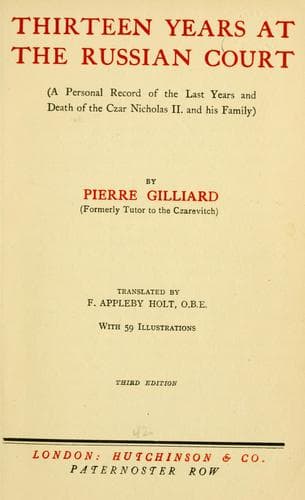
Thirteen years at the Russian court: (a personal record of the last years and death of the Czar Nicholas II. and his family)Gilliard, Pierre
History
Thirteen years at the Russian court: (a personal record of the last years and death of the Czar Nicholas II. and his family)
Gilliard, Pierre
Nicholas II, Emperor of Russia, 1868-1918; Romanov, House of; Soviet Union -- History -- Revolution, 1917-1921 -- Personal narratives
I should have preferred to confine my book to events in which I have
taken a direct part and give personal evidence only. But if I did so my
story could not be clear. In the present chapter I am compelled once
more to depart from the rule I wished to lay down for myself. If the
reader is to understand me, it is essential for me to give certain
details about the life and beginnings of Rasputin and to try and
disentangle from the legends innumerable of which he is the subject such
facts as seem to me part of history.
About one hundred and fifty versts south of Tobolsk the little village
of Pokrovskoïe lies lost in the marshes on the banks of the Tobol. There
Grigory Rasputin was born. His father’s name was Efim. Like many other
Russian peasants at that time, the latter had no family name. The
inhabitants of the village, of which he was not a native, had given him
on his arrival the name of Novy (the Newcomer).
His son Grigory had the same kind of youth as all the small peasantry of
that part of Siberia, where the poor quality of the soil often compels
them to live by expedients. Like them, he robbed and stole.... He soon
made his mark, however, by the audacity he showed in his exploits, and
it was not long before his misdoings earned him the reputation of an
unbridled libertine. He was now known solely as Rasputin, a corruption
of the word _rasputnik_ (debauched), which was destined to become, as it
were, his family name.
The villagers of Siberia were in the habit of hiring out horses to
travellers passing through the country and offering their services as
guides and coachmen. One day Rasputin happened to conduct a priest to
the monastery of Verkhoturie. The priest entered into conversation with
him, was struck by his quick natural gifts, led him by his questions to
confess his riotous life, and exhorted him to consecrate to the service
of God the vitality he was putting to such bad uses. The exhortation
produced so great an impression on Grigory that he seemed willing to
give up his life of robbery and licence. He stayed for a considerable
time at the monastery of Verkhoturie and began to frequent the holy
places of the neighbourhood.
When he went back to his village he seemed a changed man, and the
inhabitants could hardly recognise the reprobate hero of so many
scandalous adventures in this man whose countenance was so grave and
whose dress so austere. He was seen going from village to village,
spreading the good word and reciting to all and sundry willing to listen
long passages from the sacred books, which he knew by heart.
Public credulity, which he already exploited extremely skilfully, was
not slow in regarding him as a prophet, a being endowed with
supernatural powers, and in particular the power of performing miracles.
To understand this rapid transformation
[Illustration:
Si vous avez le second volume de “Notre Dame de Paris” envoyez le
moi je vous en prie.
Olga Romanoff
13. May 1914.
Public-domain text, read in full here on John Shaqi.
Reviews
Reviews
No reviews yet
Be the first to share your thoughts on this work.
Join the Discussion
Join the discussion
Sign in to leave a comment or review.
Sign InorCreate an account