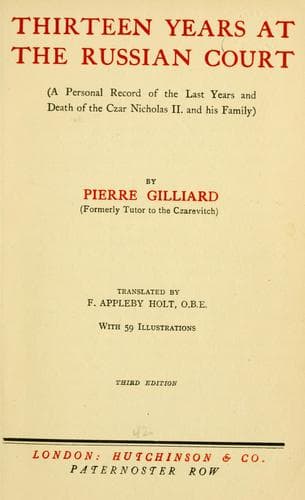
Thirteen years at the Russian court: (a personal record of the last years and death of the Czar Nicholas II. and his family) — John Shaqi
Thirteen years at the Russian court: (a personal record of the last years and death of the Czar Nicholas II. and his family)Gilliard, Pierre
History
Thirteen years at the Russian court: (a personal record of the last years and death of the Czar Nicholas II. and his family)
Gilliard, Pierre
Nicholas II, Emperor of Russia, 1868-1918; Romanov, House of; Soviet Union -- History -- Revolution, 1917-1921 -- Personal narratives
LETTER TO THE AUTHOR FROM THE GRAND-DUCHESS OLGA NICOLAÏEVNA
(LIVADIA, CRIMEA, MAY 13/26, 1914).
{_Facing page 60._]
one must realise both the strange power of fascination and suggestion
which Rasputin possessed, and also the ease with which the popular
imagination in Russia is captured by the attraction of the marvellous.
However, the virtue of the new saint does not seem to have been proof
against the enticements of the flesh for long, and he relapsed into his
debauchery. It is true that he showed the greatest contrition for his
wrongdoings, but that did not prevent him from continuing them. Even at
that time he displayed that blend of mysticism and erotomania which made
him so dangerous a person.
Yet, notwithstanding all this, his reputation spread far and wide. His
services were requisitioned, and he was sent for from distant places,
not merely in Siberia, but even in Russia.
His wanderings at last brought him to St. Petersburg. There, in 1905, he
made the acquaintance of the Archimandrite Theophanes, who thought he
could discern in him signs of genuine piety and profound humility as
well as the marks of divine inspiration. Rasputin was introduced by him
to devout circles in the capital, whither his reputation had preceded
him. He had no difficulty in trafficking in the credulity of these
devotees, whose very refinement made them superstitious and susceptible
to the magnetism of his rustic piety. In his fundamental coarseness they
saw nothing but the entertaining candour of a man of the people. They
were filled with the greatest admiration for the _naïveté_ of this
simple soul....
It was not long before Rasputin had immense authority with his new
flock. He became a familiar figure in the _salons_ of certain members of
the high aristocracy of St. Petersburg, and was even received by
members of the royal family, who sang his praises to the Czarina.
Nothing more was requisite for the last and vital stage. Rasputin was
taken to Court by intimate friends of Her Majesty, and with a personal
recommendation from the Archimandrite Theophanes. This last fact must
always be borne in mind. It was to shelter him from the attacks of his
enemies for many years.
* * * * *
We have seen how Rasputin traded on the despair which possessed the
Czarina and had contrived to link his life with that of the Czarevitch
and acquire a growing hold over his mother. Each of his appearances
seemed to produce an improvement in the boy’s malady, and thus increased
his prestige and confirmed confidence in the power of his intercession.
Public-domain text, read in full here on John Shaqi.
Reviews
Reviews
No reviews yet
Be the first to share your thoughts on this work.
Join the Discussion
Join the discussion
Sign in to leave a comment or review.
Sign InorCreate an account