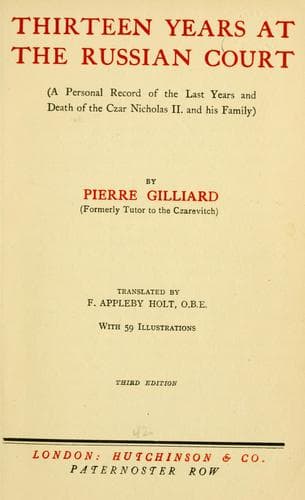
Thirteen years at the Russian court: (a personal record of the last years and death of the Czar Nicholas II. and his family) — John Shaqi
Thirteen years at the Russian court: (a personal record of the last years and death of the Czar Nicholas II. and his family)Gilliard, Pierre
History
Thirteen years at the Russian court: (a personal record of the last years and death of the Czar Nicholas II. and his family)
Gilliard, Pierre
Nicholas II, Emperor of Russia, 1868-1918; Romanov, House of; Soviet Union -- History -- Revolution, 1917-1921 -- Personal narratives
After a certain time, however, Rasputin’s head was turned by this
unexpected rise to fame; he thought his position was sufficiently
secure, forgot the caution he had displayed when he first came to St.
Petersburg, and returned to his scandalous mode of life. Yet he did so
with a skill which for a long time kept his private life quite secret.
It was only gradually that the reports of his excesses spread and were
credited.
At first only a few voices were faintly raised against the _staretz_,
but it was not long before they became loud and numerous. The first at
Court to attempt to show up the impostor was Mademoiselle Tioutcheva,
the governess of the Grand-Duchesses. Her efforts were broken against
the blind faith of the Czarina. Among the charges she made against
Rasputin were several which, in her indignation, she had not checked
with sufficient care so that their falsity was absolutely patent to her
sovereign. Realising her impotence, and with a view to discharging her
responsibilities, she asked that in any case Rasputin should not be
allowed on the floor occupied by the children.
The Czar then intervened, and Her Majesty yielded, not because her faith
was shaken, but merely for the sake of peace and in the interests of a
man whom she believed was blinded by his very zeal and devotion.
Although I was then no more than one of the Grand-Duchesses’
professors--it was during the winter of 1910--Mademoiselle Tioutcheva
herself told me all about this debate and its vicissitudes.[11] But I
confess that at that time I was still far from accepting all the
extraordinary stories about Rasputin.
In March, 1911, the hostility to Rasputin became more and more
formidable, and the _staretz_ thought it wise to let the storm blow over
and disappear for a time. He therefore started on a pilgrimage to
Jerusalem.
On his return to St. Petersburg in the autumn of the same year the
tumult had not subsided, and he had to face the attacks of one of his
former protectors, Bishop Hermogenes, who employed terrible threats and
eventually extracted a promise from Rasputin to keep away from the
Court, where his presence compromised his sovereigns.
He had no sooner left the Bishop, who had actually gone so far as to
strike him, than he rushed to his powerful protectoress, Madame
Wyroubova, the Czarina’s all but inseparable companion. The Bishop was
exiled to a monastery.
Just as futile were the efforts of the Archimandrite Theophanes, who
could never forgive himself for having stood sponsor in some degree for
the _staretz’s_ high moral character, and thus reassuring the Czar and
Czarina by his personal recommendation. He did his best to show him up,
but the only reward for his pains was to find himself transferred to the
Government of Tauris.
Public-domain text, read in full here on John Shaqi.
Reviews
Reviews
No reviews yet
Be the first to share your thoughts on this work.
Join the Discussion
Join the discussion
Sign in to leave a comment or review.
Sign InorCreate an account