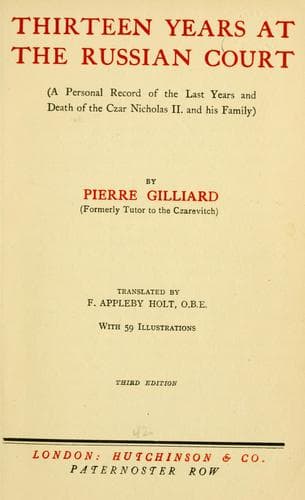
Thirteen years at the Russian court: (a personal record of the last years and death of the Czar Nicholas II. and his family)Gilliard, Pierre
History
Thirteen years at the Russian court: (a personal record of the last years and death of the Czar Nicholas II. and his family)
Gilliard, Pierre
Nicholas II, Emperor of Russia, 1868-1918; Romanov, House of; Soviet Union -- History -- Revolution, 1917-1921 -- Personal narratives
The children saw Rasputin when he was with their parents, but even at
that time his visits were infrequent. Weeks, and sometimes months,
passed without his being summoned to Court. It became more and more
usual to see him with Madame Wyroubova, who had a little house quite
near to the Alexander Palace. The Czar and his heir hardly ever went
there, and meetings were always very rare.
As I have already explained, Madame Wyroubova was the intermediary
between the Czarina and Rasputin. It was she who sent on to the
_staretz_ letters addressed to him and brought his replies--usually
verbal--to the palace.
Relations between Her Majesty and Madame Wyroubova were very intimate,
and hardly a day passed without her visiting her Imperial mistress. The
friendship had lasted many years. Madame Wyroubova had married very
young. Her husband was a degenerate and an inveterate drunkard, and
succeeded in inspiring his young wife with a deep hatred of him. They
separated, and Madame Wyroubova endeavoured to find relief and
consolation in religion. Her misfortunes were a link with the Czarina,
who had suffered so much herself, and yearned to comfort her. The young
woman who had had to go through so much won her pity. She became the
Czarina’s confidante, and the kindness the Czarina showed her made her
her lifelong slave.
Madame Wyroubova’s temperament was sentimental and mystical, and her
boundless affection for the Czarina was a positive danger, because it
was uncritical and divorced from all sense of reality.
The Czarina could not resist so fiery and sincere a devotion. Imperious
as she was, she wanted her friends to be hers, and hers alone. She only
entertained friendships in which she was quite sure of being the
dominating partner. Her confidence had to be rewarded by complete
self-abandonment. She did not realise that it was rather unwise to
encourage demonstrations of that fanatical loyalty.
Madame Wyroubova had the mind of a child, and her unhappy experiences
had sharpened her sensibilities without maturing her judgment. Lacking
in intellect and discrimination, she was the prey of her impulses. Her
opinions on men and affairs were unconsidered but none the less
sweeping. A single impression was enough to convince her limited and
puerile understanding. She at once classified people, according to the
impression they made upon her, as “good” or “bad,”--in other words,
“friends” or “enemies.”
Public-domain text, read in full here on John Shaqi.
Reviews
Reviews
No reviews yet
Be the first to share your thoughts on this work.
Join the Discussion
Join the discussion
Sign in to leave a comment or review.
Sign InorCreate an account