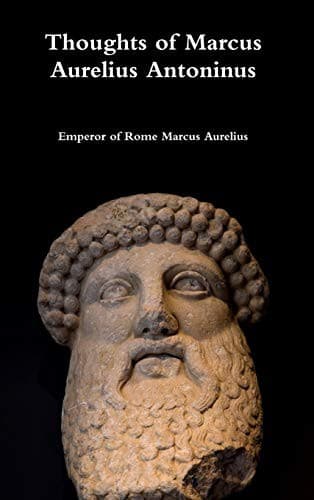
Thoughts of Marcus Aurelius Antoninus — John Shaqi
Thoughts of Marcus Aurelius AntoninusMarcus Aurelius, Emperor of Rome
PhilosophyPhilosophy
Thoughts of Marcus Aurelius Antoninus
Marcus Aurelius, Emperor of Rome
Ethics; Life; Marcus Aurelius, Emperor of Rome, 121-180; Stoics
The Stoics, and Antoninus among them, call some things beautiful
([Greek: kala]) and some ugly ([Greek: aischra]), and as they are beautiful
so they are good, and as they are ugly so they are evil, or bad (ii. 1).
All these things, good and evil, are in our power, absolutely, some of
the stricter Stoics would say; in a manner only, as those who would not
depart altogether from common sense would say; practically they are to a
great degree in the power of some persons and in some circumstances, but
in a small degree only in other persons and in other circumstances. The
Stoics maintain man's free will as to the things which are in his power;
for as to the things which are out of his power, free will terminating
in action is of course excluded by the very terms of the expression. I
hardly know if we can discover exactly Antoninus' notion of the free
will of man, nor is the question worth the inquiry. What he does mean
and does say is intelligible. All the things which are not in our power
([Greek: aproaireta]) are indifferent: they are neither good nor bad,
morally. Such are life, health, wealth, power, disease, poverty, and
death. Life and death are all men's portion. Health, wealth, power,
disease, and poverty happen to men, indifferently to the good and to the
bad; to those who live according to nature and to those who do not.[A]
"Life," says the emperor, "is a warfare and a stranger's sojourn, and
after fame is oblivion" (ii. 17). After speaking of those men who have
disturbed the world and then died, and of the death of philosophers such
as Heraclitus and Democritus, who was destroyed by lice, and of Socrates
whom other lice (his enemies) destroyed, he says: "What means all this?
Thou hast embarked, thou hast made the voyage, thou art come to shore;
get out. If indeed to another life, there is no want of gods, not even
there. But if to a state without sensation, thou wilt cease to be held
by pains and pleasures, and to be a slave to the vessel which is as much
inferior as that which serves it is superior: for the one is
intelligence and Deity; the other is earth and corruption" (iii. 3). It
is not death that a man should fear, but he should fear never beginning
to live according to nature (xii. 1). Every man should live in such a
way as to discharge his duty, and to trouble himself about nothing else.
He should live such a life that he shall always be ready for death, and
shall depart content when the summons comes. For what is death? "A
cessation of the impressions through the senses, and of the pulling of
the strings which move the appetites, and of the discursive movements of
the thoughts, and of the service to the flesh" (vi. 28). Death is such
as generation is, a mystery of nature (iv. 5). In another passage, the
exact meaning of which is perhaps doubtful (ix. 3), he speaks of the
child which leaves the womb, and so he says the soul at death leaves its
envelope. As the child is born or comes into life by leaving the womb,
Public-domain text, read in full here on John Shaqi.
Reviews
Reviews
No reviews yet
Be the first to share your thoughts on this work.
Join the Discussion
Join the discussion
Sign in to leave a comment or review.
Sign InorCreate an account