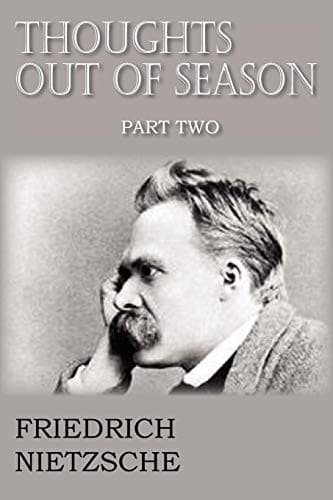
Thoughts Out of Season, Part IINietzsche, Friedrich Wilhelm
PhilosophyPhilosophy
Thoughts Out of Season, Part II
Nietzsche, Friedrich Wilhelm
History -- Study and teaching; Schopenhauer, Arthur, 1788-1860
_You can only explain the past by what is highest in the present._
Only by straining the noblest qualities you have to their highest
power will you find out what is greatest in the past, most worth
knowing and preserving. Like by like! otherwise you will draw the
past to your own level. Do not believe any history that does not
spring from the mind of a rare spirit. You will know the quality of
the spirit, by its being forced to say something universal, or to
repeat something that is known already; the fine historian must have
the power of coining the known into a thing never heard before and
proclaiming the universal so simply and profoundly that the simple is
lost in the profound, and the profound in the simple. No one can be a
great historian and artist, and a shallowpate at the same time. But
one must not despise the workers who sift and cast together the
material because they can never become great historians. They must,
still less, be confounded with them, for they are the necessary
bricklayers and apprentices in the service of the master: just as the
French used to speak, more naïvely than a German would, of the
"historiens de M. Thiers." These workmen should gradually become
extremely learned, but never, for that reason, turn to be masters.
Great learning and great shallowness go together very well under one
hat.
Thus, history is to be written by the man of experience and
character. He who has not lived through something greater and nobler
than others, will not be able to explain anything great and noble in
the past. The language of the past is always oracular: you will only
understand it as builders of the future who know the present. We can
only explain the extraordinarily wide influence of Delphi by the fact
that the Delphic priests had an exact knowledge of the past: and,
similarly, only he who is building up the future has a right to judge
the past. If you set a great aim before your eyes, you control at the
same time the itch for analysis that makes the present into a desert
for you, and all rest, all peaceful growth and ripening, impossible.
Hedge yourselves with a great, all-embracing hope, and strive on.
Make of yourselves a mirror where the future may see itself, and
forget the superstition that you are Epigoni. You have enough to
ponder and find out, in pondering the life of the future: but do not
ask history to show you the means and the instrument to it. If you
live yourselves back into the history of great men, you will find in
it the high command to come to maturity and leave that blighting
system of cultivation offered by your time: which sees its own profit
in not allowing you to become ripe, that it may use and dominate you
while you are yet unripe. And if you want biographies, do not look
for those with the legend "Mr. So-and-so and his times," but for one
whose title-page might be inscribed "a fighter against his time."
Feast your souls on Plutarch, and dare to believe in yourselves when
you believe in his heroes.
Public-domain text, read in full here on John Shaqi.
Reviews
Reviews
No reviews yet
Be the first to share your thoughts on this work.
Join the Discussion
Join the discussion
Sign in to leave a comment or review.
Sign InorCreate an account