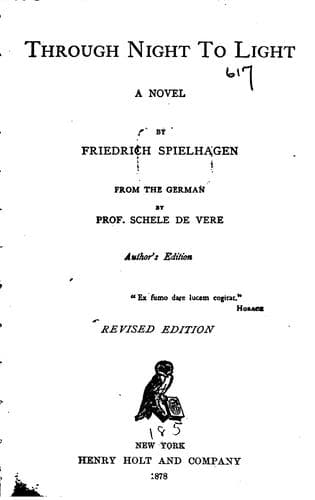
Through Night to Light: A NovelSpielhagen, Friedrich
General
Through Night to Light: A Novel
Spielhagen, Friedrich
Fiction
"I must confess, to be candid, that the refined and the unrefined
rabble were not so far amiss when they attributed to my father ideas
and notions which are not ordinarily met with in the brains of the
majority. He had a supreme contempt for all faith founded merely upon
authority, because he felt himself fettered by it in the freedom of his
existence; and an intense hatred for all worldly tyranny, because it
prevented him from acting freely. He openly declared a republic to be
the only form of government under which a man who had the right _point
d'honneur_ could live happily. Every prerogative granted to one, to a
few, or to the many, was to him an injustice, which could only be
explained by the insolence of the ruler and the cowardice of the ruled.
He could see no difference in the end between a flock of sheep driven
to the slaughter-house by a stupid servant and a savage dog, and a
people who allowed themselves to be oppressed and ill-treated by a
proportionately small number of men. The men, he said, only managed to
cover their disgrace with bright-colored garments, while the sheep were
not able to do the same.
"His special hatred, however, was given to the nobility. As soon as he
happened to speak of their caste, he had a whole dictionary of
opprobrious epithets at his command. He never entered the house of a
nobleman; and whenever young men of noble birth proposed to take
lessons from him, he immediately refused. Once, as we were firing at a
target--a practice in which he excelled--he told me that in his youth
he had hoped thus to engage himself against a nobleman who had mortally
offended him. Unfortunately the man had died before he could carry out
his plan. That is the only hint which I ever received as to my father's
former life.
"And thus I grew up, exclusively communing with this strange man. The
relations between us were as extraordinary as he himself. Although my
father did more for me than generally both parents jointly do for their
child, and although he apparently lived and suffered only for my sake,
I still do not think he really loved me. He was a purely spiritual man.
Either his heart had received, at some time or other, a fatal blow from
which it had never recovered, or his sentiments had all evaporated into
mere notions under the influence of his scepticism. Whatever he did, he
did from a sense of duty, from a conviction that it was right; for, as
he said himself, Justice is higher than Love; it does all that Love
does and a great deal more.
Public-domain text, read in full here on John Shaqi.
Reviews
Reviews
No reviews yet
Be the first to share your thoughts on this work.
Join the Discussion
Join the discussion
Sign in to leave a comment or review.
Sign InorCreate an account