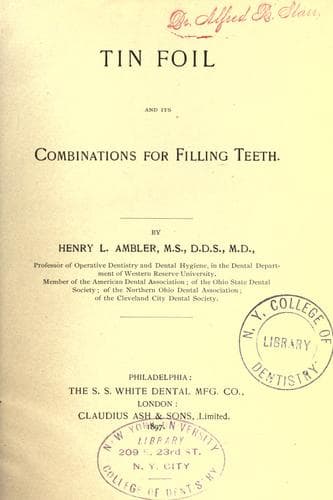
Tin Foil and Its Combinations for Filling TeethAmbler, Henry Lovejoy
Science
Tin Foil and Its Combinations for Filling Teeth
Ambler, Henry Lovejoy
Dentistry
From the best information obtainable, the writer believes that Marcus
Bull (the predecessor of Abbey) was the first to manufacture and sell
tin foil in the United States, as he began the manufacture of gold foil
at Hartford in 1812.
Several years ago a radical change came about in the preparation of tin
foil, for which the manufacturer should have his share of the credit,
even if the dentist did ask for something better, for the quality
depends largely upon the kind and condition of the tin used and on the
method of manufacture.
For making tin foil for filling teeth, the purest Banca tin that can be
obtained is used. The tin is melted in a crucible under a cover of
powdered charcoal. It is then cast into a bar and rolled to the desired
thickness, so that if No. 6 foil is to be made, a piece one and one-half
(1-1/2) inches square would weigh nine grains. This ribbon is then cut
into lengths of about four feet, and spread on a smooth board slanted,
so that the end rests in a vat of clean water.
Then apply to the exposed surface of the ribbon diluted muriatic acid,
and immediately wash with a strong solution of ammonia. Turn the ribbon
and treat the other side in the same way. It is then washed and rubbed
dry. The object of using the acid is to remove stains and whiten the
tin, and the ammonia is used to neutralize the effect of the acid.
The strips are then cut into pieces one and a half inch square, filled
into a cutch and beaten to about three inches square. It is then removed
from the cutch and filled into a mold, and further beaten to the desired
size. When the ragged edges are trimmed off, the foil is ready for
booking.
It takes skill and experience to beat tin foil, for it is not nearly as
malleable as gold; up to No. 20 it is usually beaten, but higher numbers
are prepared by rolling. In each case the process is similar to that
employed in preparing gold foil. The number on the book is supposed to
indicate the weight or thickness of the leaf. On the lower numbers the
paper of the book leaves its impression.
Public-domain text, read in full here on John Shaqi.
Reviews
Reviews
No reviews yet
Be the first to share your thoughts on this work.
Join the Discussion
Join the discussion
Sign in to leave a comment or review.
Sign InorCreate an account