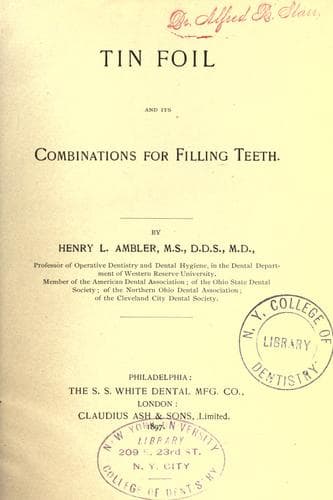
Tin Foil and Its Combinations for Filling TeethAmbler, Henry Lovejoy
Science
Tin Foil and Its Combinations for Filling Teeth
Ambler, Henry Lovejoy
Dentistry
"A constant galvanic action is kept up in the mouth when more than one
kind of metal is used in filling teeth, and galvanism is often the
cause of extensive injury to the teeth. The most remarkable case I ever
saw was that of a lady for whom I filled several teeth with tin. After a
time decay took place around some of the fillings. I removed them and
began to refill, but there was so much pain I could not proceed. I found
that by holding a steel plugger an inch from the tooth I could give her
a violent galvanic shock. I observed that the exhalation of the breath
increased the evolution of galvanism." (Dr. L. Mackall, _American
Journal of Dental Science_, 1839.)
"When a faulty tooth in the upper jaw had been stopped from its side
with tin, the interstice between it and the adjoining tooth being quite
inconsiderable, while the upper surface of a tooth not immediately
beneath it in the lower jaw was stopped with the same metal, I have
known a galvanic shock regularly communicated from one tooth to the
other when by the movement of jaws or cheeks they were brought near
together." (Dr. E. Parmly, _American Journal of Dental Science_, 1839.)
"An interesting debate here sprung up on the action where two metals are
used in one filling, such as gold and tin, the saliva acting as a
medium, and where the baser metal is oxidized by exhalents and by
imbibition through the bony tooth-structure." (Pennsylvania Society of
Dental Surgeons, 1848.)
"A patient came to me and complained of pain in the teeth. Upon
examination I found an amalgam filling next to one of tin. With a file I
made a V-shaped separation, when they experienced immediate relief from
pain." (Dr. Nevill, _American Journal of Dental Science_, 1867.)
In regard to the decay of teeth being dependent on galvanic action
present in the mouth, Dr. Chase, in 1880, claimed that a tooth filled
with gold would necessarily become carious again at the margin of the
cavity, wherever the acid secretions constantly bathe the filling and
tooth-substance. A tooth filled with amalgam succumbs to this
electro-chemical process less rapidly, while one filled with tin still
longer escapes destruction. The comparative rapidity with which teeth
filled with gold, amalgam, or tin, are destroyed is expressed by the
numbers 100, 67, 50. He prepared pieces of ivory of equal shape and
size, bored a hole in each, and filled them. After they had been exposed
to the action of an acid for one week, they had decreased in
weight,--viz, piece filled with gold, 0.06; amalgam, 0.04; tin, 0.03.
Public-domain text, read in full here on John Shaqi.
Reviews
Reviews
No reviews yet
Be the first to share your thoughts on this work.
Join the Discussion
Join the discussion
Sign in to leave a comment or review.
Sign InorCreate an account